6.引用类型
文档摘要
title: 6. 引用类型 tags: solidity basic wtfacademy array/struct WTF Solidity极简入门: 6. 引用类型, array, struct 我最近在重新学 Solidity,巩固一下细节,也写一个“WTF Solidity极简入门”,供小白们使用(编程大佬可以另找教程),每周更新 1-3 讲。 推特:@0xAAScience|@WTFAcademy 社区:Discord|微信群|官网 wtf.academy 所有代码和教程开源在 github: github.com/AmazingAng/WTF-Solidity 这一讲,我们将介绍 中的两个重要变量类型:数组( )和结构体( )。
title: 6. 引用类型 tags: - solidity - basic - wtfacademy - array/struct
WTF Solidity极简入门: 6. 引用类型, array, struct
我最近在重新学 Solidity,巩固一下细节,也写一个“WTF Solidity极简入门”,供小白们使用(编程大佬可以另找教程),每周更新 1-3 讲。
所有代码和教程开源在 github: github.com/AmazingAng/WTF-Solidity
这一讲,我们将介绍Solidity中的两个重要变量类型:数组(array)和结构体(struct)。
数组 array
数组(Array)是Solidity常用的一种变量类型,用来存储一组数据(整数,字节,地址等等)。数组分为固定长度数组和可变长度数组两种:
-
固定长度数组:在声明时指定数组的长度。用
T[k]的格式声明,其中T是元素的类型,k是长度,例如:// 固定长度 Array uint[8] array1; bytes1[5] array2; address[100] array3; -
可变长度数组(动态数组):在声明时不指定数组的长度。用
T[]的格式声明,其中T是元素的类型,例如:// 可变长度 Array uint[] array4; bytes1[] array5; address[] array6; bytes array7;注意:
bytes比较特殊,是数组,但是不用加[]。另外,不能用byte[]声明单字节数组,可以使用bytes或bytes1[]。bytes比bytes1[]省gas。
创建数组的规则
在Solidity里,创建数组有一些规则:
-
对于
memory修饰的动态数组,可以用new操作符来创建,但是必须声明长度,并且声明后长度不能改变。例子:// memory动态数组 uint[] memory array8 = new uint[](5); bytes memory array9 = new bytes(9); -
数组字面常数(Array Literals)是写作表达式形式的数组,用方括号包着来初始化array的一种方式,并且里面每一个元素的type是以第一个元素为准的,例如
[1,2,3]里面所有的元素都是uint8类型,因为在Solidity中,如果一个值没有指定type的话,会根据上下文推断出元素的类型,默认就是最小单位的type,这里默认最小单位类型是uint8。而[uint(1),2,3]里面的元素都是uint类型,因为第一个元素指定了是uint类型了,里面每一个元素的type都以第一个元素为准。下面的例子中,如果没有对传入
g()函数的数组进行uint转换,是会报错的。// SPDX-License-Identifier: GPL-3.0 pragma solidity >=0.4.16 <0.9.0; contract C { function f() public pure { g([uint(1), 2, 3]); } function g(uint[3] memory _data) public pure { // ... } } -
如果创建的是动态数组,你需要一个一个元素的赋值。
uint[] memory x = new uint[](3); x[0] = 1; x[1] = 3; x[2] = 4;
数组成员
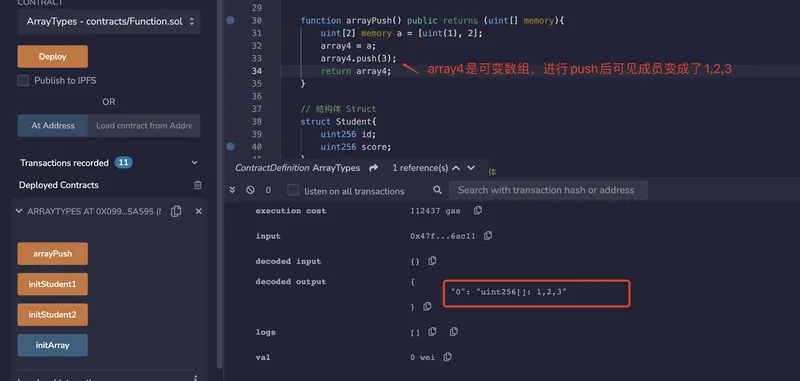
length: 数组有一个包含元素数量的length成员,memory数组的长度在创建后是固定的。push():动态数组拥有push()成员,可以在数组最后添加一个0元素,并返回该元素的引用。push(x):动态数组拥有push(x)成员,可以在数组最后添加一个x元素。pop():动态数组拥有pop()成员,可以移除数组最后一个元素。
Example:
https://www.aiknowledge.cn/images/WTF-Solidity/6-1.webp
结构体 struct
Solidity支持通过构造结构体的形式定义新的类型。结构体中的元素可以是原始类型,也可以是引用类型;结构体可以作为数组或映射的元素。创建结构体的方法:
// 结构体 struct Student{ uint256 id; uint256 score; } Student student; // 初始一个student结构体
给结构体赋值的四种方法:
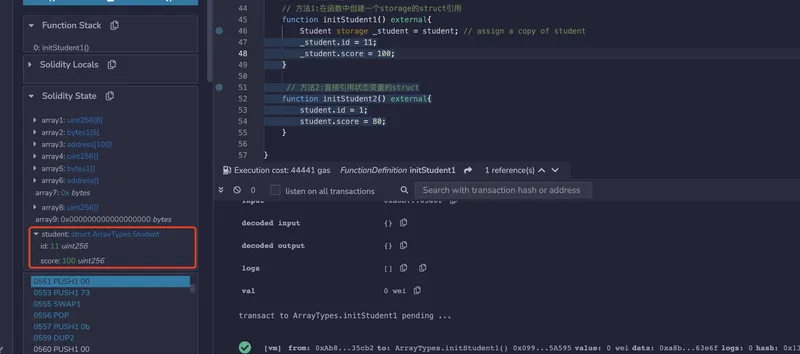
// 给结构体赋值 // 方法1:在函数中创建一个storage的struct引用 function initStudent1() external{ Student storage _student = student; // assign a copy of student _student.id = 11; _student.score = 100; }
Example:
https://www.aiknowledge.cn/images/WTF-Solidity/6-2.webp
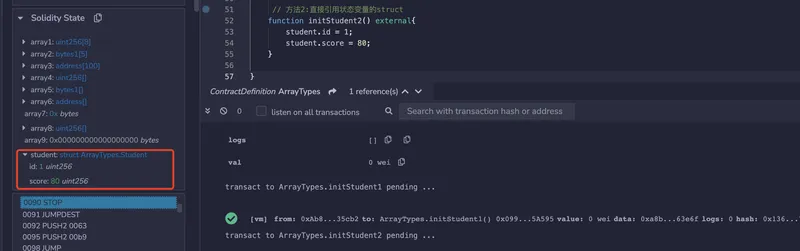
// 方法2:直接引用状态变量的struct function initStudent2() external{ student.id = 1; student.score = 80; }
Example:
https://www.aiknowledge.cn/images/WTF-Solidity/6-3.webp
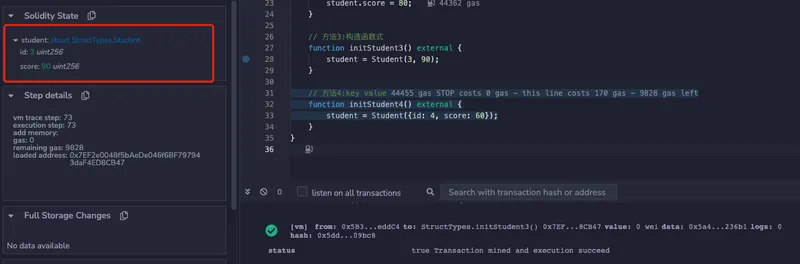
// 方法3:构造函数式 function initStudent3() external { student = Student(3, 90); }
Example:
https://www.aiknowledge.cn/images/WTF-Solidity/6-4.webp
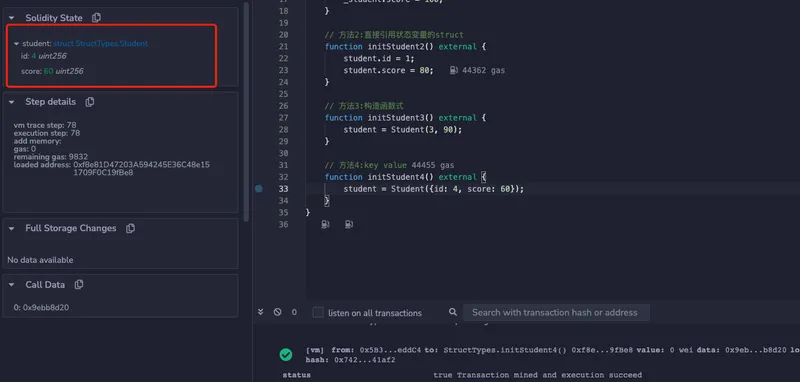
// 方法4:key value function initStudent4() external { student = Student({id: 4, score: 60}); }
Example:
https://www.aiknowledge.cn/images/WTF-Solidity/6-5.webp
总结
这一讲,我们介绍了Solidity中数组(array)和结构体(struct)的基本用法。下一讲我们将介绍Solidity中的哈希表——映射(mapping)。