0122.买卖股票的最佳时机II
文档摘要
参与本项目 ,贡献其他语言版本的代码,拥抱开源,让更多学习算法的小伙伴们受益! 122.买卖股票的最佳时机 II 力扣题目链接 给定一个数组,它的第 i 个元素是一支给定股票第 i 天的价格。 设计一个算法来计算你所能获取的最大利润。你可以尽可能地完成更多的交易(多次买卖一支股票)。 注意:你不能同时参与多笔交易(你必须在再次购买前出售掉之前的股票)。 示例 1: 输入: [7,1,5,3,6,4] 输出: 7 解释: 在第 2 天(股票价格 = 1)的时候买入,在第 3 天(股票价格 = 5)的时候卖出, 这笔交易所能获得利润 = 5-1 = 4。随后,在第 4 天(股票价格 = 3)的时候买入,在第 5 天(股票价格 = 6)的时候卖出, 这笔交易所能获得利润 = 6-3 = 3 。

参与本项目,贡献其他语言版本的代码,拥抱开源,让更多学习算法的小伙伴们受益!
122.买卖股票的最佳时机 II
给定一个数组,它的第 i 个元素是一支给定股票第 i 天的价格。
设计一个算法来计算你所能获取的最大利润。你可以尽可能地完成更多的交易(多次买卖一支股票)。
注意:你不能同时参与多笔交易(你必须在再次购买前出售掉之前的股票)。
示例 1:
- 输入: [7,1,5,3,6,4]
- 输出: 7
- 解释: 在第 2 天(股票价格 = 1)的时候买入,在第 3 天(股票价格 = 5)的时候卖出, 这笔交易所能获得利润 = 5-1 = 4。随后,在第 4 天(股票价格 = 3)的时候买入,在第 5 天(股票价格 = 6)的时候卖出, 这笔交易所能获得利润 = 6-3 = 3 。
示例 2:
- 输入: [1,2,3,4,5]
- 输出: 4
- 解释: 在第 1 天(股票价格 = 1)的时候买入,在第 5 天 (股票价格 = 5)的时候卖出, 这笔交易所能获得利润 = 5-1 = 4 。注意你不能在第 1 天和第 2 天接连购买股票,之后再将它们卖出。因为这样属于同时参与了多笔交易,你必须在再次购买前出售掉之前的股票。
示例 3:
- 输入: [7,6,4,3,1]
- 输出: 0
- 解释: 在这种情况下, 没有交易完成, 所以最大利润为 0。
提示:
- 1 <= prices.length <= 3 * 10 ^ 4
- 0 <= prices[i] <= 10 ^ 4
算法公开课
《代码随想录》算法视频公开课:,相信结合视频在看本篇题解,更有助于大家对本题的理解。
思路
本题首先要清楚两点:
- 只有一只股票!
- 当前只有买股票或者卖股票的操作
想获得利润至少要两天为一个交易单元。
贪心算法
这道题目可能我们只会想,选一个低的买入,再选个高的卖,再选一个低的买入.....循环反复。
如果想到其实最终利润是可以分解的,那么本题就很容易了!
如何分解呢?
假如第 0 天买入,第 3 天卖出,那么利润为:prices[3] - prices[0]。
相当于(prices[3] - prices[2]) + (prices[2] - prices[1]) + (prices[1] - prices[0])。
此时就是把利润分解为每天为单位的维度,而不是从 0 天到第 3 天整体去考虑!
那么根据 prices 可以得到每天的利润序列:(prices[i] - prices[i - 1]).....(prices[1] - prices[0])。
如图:
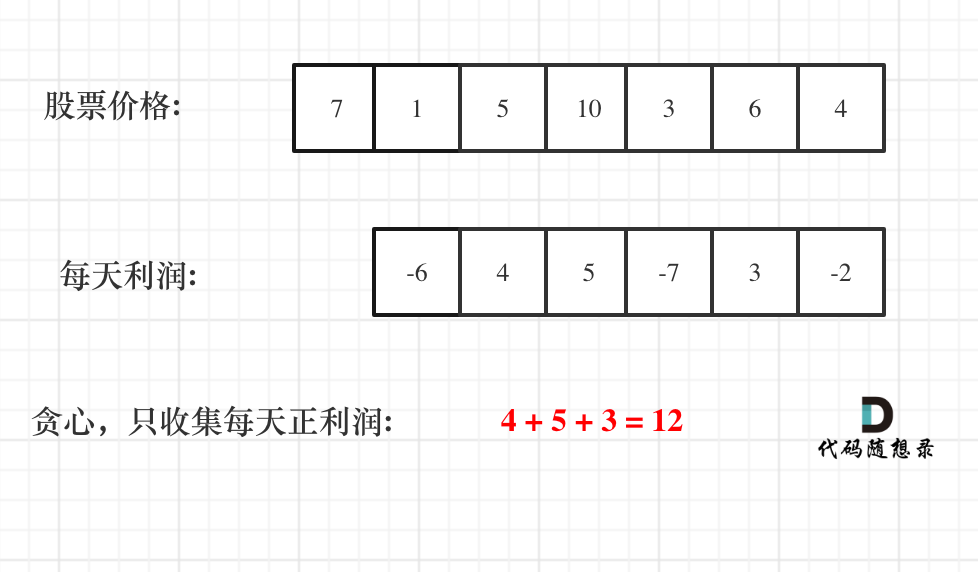
一些同学陷入:第一天怎么就没有利润呢,第一天到底算不算的困惑中。
第一天当然没有利润,至少要第二天才会有利润,所以利润的序列比股票序列少一天!
从图中可以发现,其实我们需要收集每天的正利润就可以,收集正利润的区间,就是股票买卖的区间,而我们只需要关注最终利润,不需要记录区间。
那么只收集正利润就是贪心所贪的地方!
局部最优:收集每天的正利润,全局最优:求得最大利润。
局部最优可以推出全局最优,找不出反例,试一试贪心!
对应 C++代码如下:
class Solution { public: int maxProfit(vector<int>& prices) { int result = 0; for (int i = 1; i < prices.size(); i++) { result += max(prices[i] - prices[i - 1], 0); } return result; } };
- 时间复杂度:O(n)
- 空间复杂度:O(1)
动态规划
动态规划将在下一个系列详细讲解,本题解先给出我的 C++代码(带详细注释),想先学习的话,可以看本篇:122.买卖股票的最佳时机II(动态规划)
class Solution { public: int maxProfit(vector<int>& prices) { // dp[i][1]第i天持有的最多现金 // dp[i][0]第i天持有股票后的最多现金 int n = prices.size(); vector<vector<int>> dp(n, vector<int>(2, 0)); dp[0][0] -= prices[0]; // 持股票 for (int i = 1; i < n; i++) { // 第i天持股票所剩最多现金 = max(第i-1天持股票所剩现金, 第i-1天持现金-买第i天的股票) dp[i][0] = max(dp[i - 1][0], dp[i - 1][1] - prices[i]); // 第i天持有最多现金 = max(第i-1天持有的最多现金,第i-1天持有股票的最多现金+第i天卖出股票) dp[i][1] = max(dp[i - 1][1], dp[i - 1][0] + prices[i]); } return max(dp[n - 1][0], dp[n - 1][1]); } };
- 时间复杂度:O(n)
- 空间复杂度:O(n)
总结
股票问题其实是一个系列的,属于动态规划的范畴,因为目前在讲解贪心系列,所以股票问题会在之后的动态规划系列中详细讲解。
可以看出有时候,贪心往往比动态规划更巧妙,更好用,所以别小看了贪心算法。
本题中理解利润拆分是关键点! 不要整块的去看,而是把整体利润拆为每天的利润。
一旦想到这里了,很自然就会想到贪心了,即:只收集每天的正利润,最后稳稳的就是最大利润了。
其他语言版本
Java:
贪心:
// 贪心思路 class Solution { public int maxProfit(int[] prices) { int result = 0; for (int i = 1; i < prices.length; i++) { result += Math.max(prices[i] - prices[i - 1], 0); } return result; } }
动态规划:
class Solution { // 动态规划 public int maxProfit(int[] prices) { // [天数][是否持有股票] int[][] dp = new int[prices.length][2]; // base case dp[0][0] = 0; dp[0][1] = -prices[0]; for (int i = 1; i < prices.length; i++) { // dp公式 dp[i][0] = Math.max(dp[i - 1][0], dp[i - 1][1] + prices[i]); dp[i][1] = Math.max(dp[i - 1][1], dp[i - 1][0] - prices[i]); } return dp[prices.length - 1][0]; } }
Python:
贪心:
class Solution: def maxProfit(self, prices: List[int]) -> int: result = 0 for i in range(1, len(prices)): result += max(prices[i] - prices[i - 1], 0) return result
动态规划:
class Solution: def maxProfit(self, prices: List[int]) -> int: length = len(prices) dp = [[0] * 2 for _ in range(length)] dp[0][0] = -prices[0] dp[0][1] = 0 for i in range(1, length): dp[i][0] = max(dp[i-1][0], dp[i-1][1] - prices[i]) #注意这里是和121. 买卖股票的最佳时机唯一不同的地方 dp[i][1] = max(dp[i-1][1], dp[i-1][0] + prices[i]) return dp[-1][1]
Go:
贪心算法
func maxProfit(prices []int) int { var sum int for i := 1; i < len(prices); i++ { // 累加每次大于0的交易 if prices[i] - prices[i-1] > 0 { sum += prices[i] - prices[i-1] } } return sum }
动态规划
func maxProfit(prices []int) int { dp := make([][]int, len(prices)) for i := 0; i < len(dp); i++ { dp[i] = make([]int, 2) } // dp[i][0]表示在状态i不持有股票的现金,dp[i][1]为持有股票的现金 dp[0][0], dp[0][1] = 0, -prices[0] for i := 1; i < len(prices); i++ { dp[i][0] = max(dp[i-1][0], dp[i-1][1] + prices[i]) dp[i][1] = max(dp[i-1][0] - prices[i], dp[i-1][1]) } return dp[len(prices)-1][0] } func max(a, b int) int { if a > b { return a } return b }
Javascript:
贪心
var maxProfit = function(prices) { let result = 0 for(let i = 1; i < prices.length; i++) { result += Math.max(prices[i] - prices[i - 1], 0) } return result };
动态规划
const maxProfit = (prices) => { let dp = Array.from(Array(prices.length), () => Array(2).fill(0)); // dp[i][0] 表示第i天持有股票所得现金。 // dp[i][1] 表示第i天不持有股票所得最多现金 dp[0][0] = 0 - prices[0]; dp[0][1] = 0; for (let i = 1; i < prices.length; i++) { // 如果第i天持有股票即dp[i][0], 那么可以由两个状态推出来 // 第i-1天就持有股票,那么就保持现状,所得现金就是昨天持有股票的所得现金 即:dp[i - 1][0] // 第i天买入股票,所得现金就是昨天不持有股票的所得现金减去 今天的股票价格 即:dp[i - 1][1] - prices[i] dp[i][0] = Math.max(dp[i - 1][0], dp[i - 1][1] - prices[i]); // 在来看看如果第i天不持有股票即dp[i][1]的情况, 依然可以由两个状态推出来 // 第i-1天就不持有股票,那么就保持现状,所得现金就是昨天不持有股票的所得现金 即:dp[i - 1][1] // 第i天卖出股票,所得现金就是按照今天股票佳价格卖出后所得现金即:prices[i] + dp[i - 1][0] dp[i][1] = Math.max(dp[i - 1][1], dp[i - 1][0] + prices[i]); } return dp[prices.length - 1][1]; };
TypeScript:
贪心
function maxProfit(prices: number[]): number { let resProfit: number = 0; for (let i = 1, length = prices.length; i < length; i++) { resProfit += Math.max(prices[i] - prices[i - 1], 0); } return resProfit; }
动态规划
function maxProfit(prices: number[]): number { const dp = Array(prices.length) .fill(0) .map(() => Array(2).fill(0)) dp[0][0] = -prices[0] for (let i = 1; i < prices.length; i++) { dp[i][0] = Math.max(dp[i - 1][0], dp[i - 1][1] - prices[i]) dp[i][1] = Math.max(dp[i - 1][1], dp[i - 1][0] + prices[i]) } return dp[prices.length - 1][1] }
Rust:
贪心:
impl Solution { pub fn max_profit(prices: Vec<i32>) -> i32 { let mut result = 0; for i in 1..prices.len() { result += (prices[i] - prices[i - 1]).max(0); } result } }
动态规划:
impl Solution { pub fn max_profit(prices: Vec<i32>) -> i32 { let mut dp = vec![vec![0; 2]; prices.len()]; dp[0][0] = -prices[0]; for i in 1..prices.len() { dp[i][0] = dp[i - 1][0].max(dp[i - 1][1] - prices[i]); dp[i][1] = dp[i - 1][1].max(dp[i - 1][0] + prices[i]); } dp[prices.len() - 1][1] } }
C:
贪心:
int maxProfit(int* prices, int pricesSize){ int result = 0; int i; //从第二个元素开始遍历数组,与之前的元素进行比较 for(i = 1; i < pricesSize; ++i) { //若该元素比前面元素大,则说明有利润。代表买入 if(prices[i] > prices[i-1]) result+= prices[i]-prices[i-1]; } return result; }
动态规划:
#define max(a, b) (((a) > (b)) ? (a) : (b)) int maxProfit(int* prices, int pricesSize){ int dp[pricesSize][2]; dp[0][0] = 0 - prices[0]; dp[0][1] = 0; int i; for(i = 1; i < pricesSize; ++i) { // dp[i][0]为i-1天持股的钱数/在第i天用i-1天的钱买入的最大值。 // 若i-1天持股,且第i天买入股票比i-1天持股时更亏,说明应在i-1天时持股 dp[i][0] = max(dp[i-1][0], dp[i-1][1] - prices[i]); //dp[i][1]为i-1天不持股钱数/在第i天卖出所持股票dp[i-1][0] + prices[i]的最大值 dp[i][1] = max(dp[i-1][1], dp[i-1][0] + prices[i]); } // 返回在最后一天不持股时的钱数(将股票卖出后钱最大化) return dp[pricesSize - 1][1]; }
Scala:
贪心:
object Solution { def maxProfit(prices: Array[Int]): Int = { var result = 0 for (i <- 1 until prices.length) { if (prices(i) > prices(i - 1)) { result += prices(i) - prices(i - 1) } } result } }
C#
public class Solution { public int MaxProfit(int[] prices) { int res = 0; for (int i = 0; i < prices.Length - 1; i++) { res += Math.Max(0, prices[i + 1] - prices[i]); } return res; } }
