0150.逆波兰表达式求值
文档摘要
参与本项目 ,贡献其他语言版本的代码,拥抱开源,让更多学习算法的小伙伴们受益! 这不仅仅是一道好题,也展现出计算机的思考方式 逆波兰表达式求值 力扣题目链接 根据 逆波兰表示法,求表达式的值。 有效的运算符包括 + , - , , / 。每个运算对象可以是整数,也可以是另一个逆波兰表达式。 说明: 整数除法只保留整数部分。 给定逆波兰表达式总是有效的。换句话说,表达式总会得出有效数值且不存在除数为 0 的情况。

参与本项目,贡献其他语言版本的代码,拥抱开源,让更多学习算法的小伙伴们受益!
这不仅仅是一道好题,也展现出计算机的思考方式
150. 逆波兰表达式求值
根据 逆波兰表示法,求表达式的值。
有效的运算符包括 + , - , * , / 。每个运算对象可以是整数,也可以是另一个逆波兰表达式。
说明:
整数除法只保留整数部分。
给定逆波兰表达式总是有效的。换句话说,表达式总会得出有效数值且不存在除数为 0 的情况。
示例 1:
- 输入: ["2", "1", "+", "3", " * "]
- 输出: 9
- 解释: 该算式转化为常见的中缀算术表达式为:((2 + 1) * 3) = 9
示例 2:
- 输入: ["4", "13", "5", "/", "+"]
- 输出: 6
- 解释: 该算式转化为常见的中缀算术表达式为:(4 + (13 / 5)) = 6
示例 3:
-
输入: ["10", "6", "9", "3", "+", "-11", " * ", "/", " * ", "17", "+", "5", "+"]
-
输出: 22
-
解释:该算式转化为常见的中缀算术表达式为:
((10 * (6 / ((9 + 3) * -11))) + 17) + 5 = ((10 * (6 / (12 * -11))) + 17) + 5 = ((10 * (6 / -132)) + 17) + 5 = ((10 * 0) + 17) + 5 = (0 + 17) + 5 = 17 + 5 = 22
逆波兰表达式:是一种后缀表达式,所谓后缀就是指运算符写在后面。
平常使用的算式则是一种中缀表达式,如 ( 1 + 2 ) * ( 3 + 4 ) 。
该算式的逆波兰表达式写法为 ( ( 1 2 + ) ( 3 4 + ) * ) 。
逆波兰表达式主要有以下两个优点:
-
去掉括号后表达式无歧义,上式即便写成 1 2 + 3 4 + * 也可以依据次序计算出正确结果。
-
适合用栈操作运算:遇到数字则入栈;遇到运算符则取出栈顶两个数字进行计算,并将结果压入栈中。
算法公开课
《代码随想录》算法视频公开课:,相信结合视频再看本篇题解,更有助于大家对本题的理解。
思路
正题
在上一篇文章中1047.删除字符串中的所有相邻重复项提到了 递归就是用栈来实现的。
所以栈与递归之间在某种程度上是可以转换的! 这一点我们在后续讲解二叉树的时候,会更详细的讲解到。
那么来看一下本题,其实逆波兰表达式相当于是二叉树中的后序遍历。 大家可以把运算符作为中间节点,按照后序遍历的规则画出一个二叉树。
但我们没有必要从二叉树的角度去解决这个问题,只要知道逆波兰表达式是用后序遍历的方式把二叉树序列化了,就可以了。
在进一步看,本题中每一个子表达式要得出一个结果,然后拿这个结果再进行运算,那么这岂不就是一个相邻字符串消除的过程,和1047.删除字符串中的所有相邻重复项中的对对碰游戏是不是就非常像了。
如动画所示: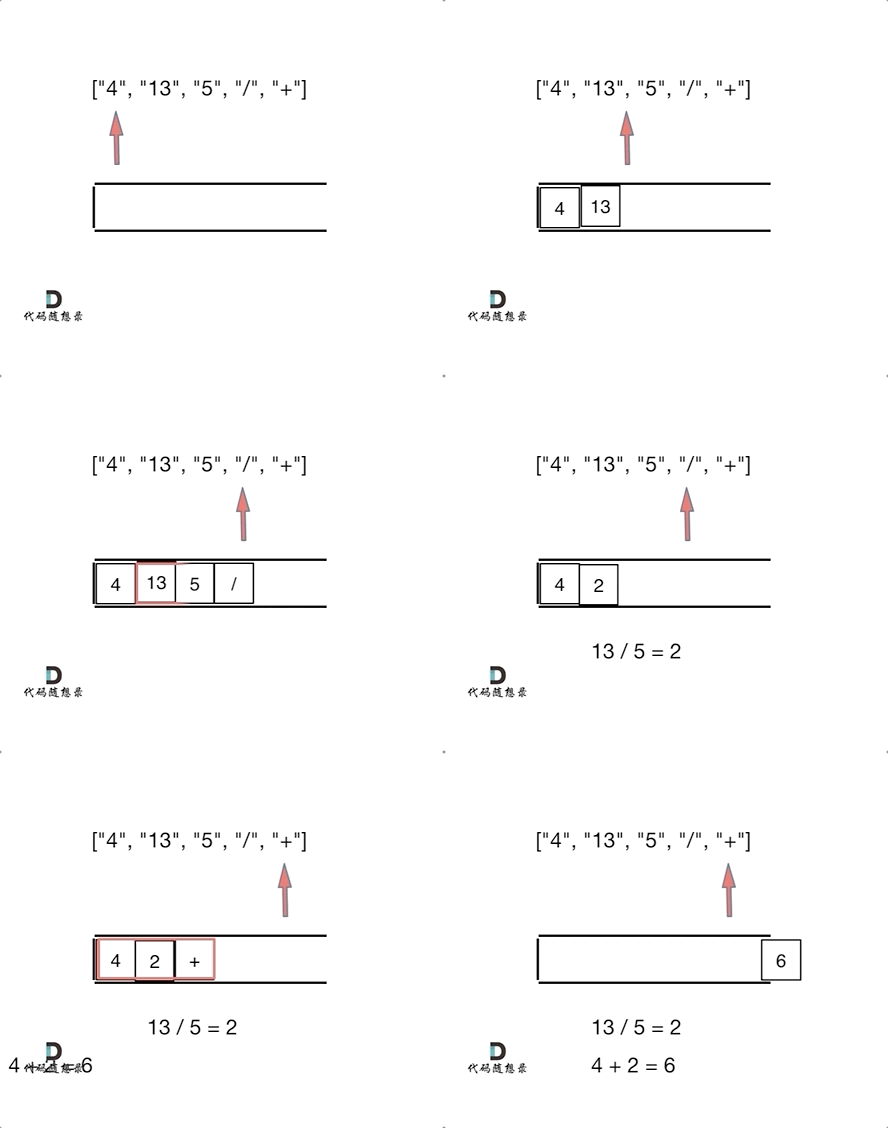
相信看完动画大家应该知道,这和1047. 删除字符串中的所有相邻重复项是差不多的,只不过本题不要相邻元素做消除了,而是做运算!
C++代码如下:
class Solution { public: int evalRPN(vector<string>& tokens) { // 力扣修改了后台测试数据,需要用longlong stack<long long> st; for (int i = 0; i < tokens.size(); i++) { if (tokens[i] == "+" || tokens[i] == "-" || tokens[i] == "*" || tokens[i] == "/") { long long num1 = st.top(); st.pop(); long long num2 = st.top(); st.pop(); if (tokens[i] == "+") st.push(num2 + num1); if (tokens[i] == "-") st.push(num2 - num1); if (tokens[i] == "*") st.push(num2 * num1); if (tokens[i] == "/") st.push(num2 / num1); } else { st.push(stoll(tokens[i])); } } long long result = st.top(); st.pop(); // 把栈里最后一个元素弹出(其实不弹出也没事) return result; } };
- 时间复杂度: O(n)
- 空间复杂度: O(n)
题外话
我们习惯看到的表达式都是中缀表达式,因为符合我们的习惯,但是中缀表达式对于计算机来说就不是很友好了。
例如:4 + 13 / 5,这就是中缀表达式,计算机从左到右去扫描的话,扫到13,还要判断13后面是什么运算符,还要比较一下优先级,然后13还和后面的5做运算,做完运算之后,还要向前回退到 4 的位置,继续做加法,你说麻不麻烦!
那么将中缀表达式,转化为后缀表达式之后:["4", "13", "5", "/", "+"] ,就不一样了,计算机可以利用栈来顺序处理,不需要考虑优先级了。也不用回退了, 所以后缀表达式对计算机来说是非常友好的。
可以说本题不仅仅是一道好题,也展现出计算机的思考方式。
在1970年代和1980年代,惠普在其所有台式和手持式计算器中都使用了RPN(后缀表达式),直到2020年代仍在某些模型中使用了RPN。
参考维基百科如下:
During the 1970s and 1980s, Hewlett-Packard used RPN in all of their desktop and hand-held calculators, and continued to use it in some models into the 2020s.
其他语言版本
Java:
class Solution { public int evalRPN(String[] tokens) { Deque<Integer> stack = new LinkedList(); for (String s : tokens) { if ("+".equals(s)) { // leetcode 内置jdk的问题,不能使用==判断字符串是否相等 stack.push(stack.pop() + stack.pop()); // 注意 - 和/ 需要特殊处理 } else if ("-".equals(s)) { stack.push(-stack.pop() + stack.pop()); } else if ("*".equals(s)) { stack.push(stack.pop() * stack.pop()); } else if ("/".equals(s)) { int temp1 = stack.pop(); int temp2 = stack.pop(); stack.push(temp2 / temp1); } else { stack.push(Integer.valueOf(s)); } } return stack.pop(); } }
Python3:
from operator import add, sub, mul def div(x, y): # 使用整数除法的向零取整方式 return int(x / y) if x * y > 0 else -(abs(x) // abs(y)) class Solution(object): op_map = {'+': add, '-': sub, '*': mul, '/': div} def evalRPN(self, tokens: List[str]) -> int: stack = [] for token in tokens: if token not in {'+', '-', '*', '/'}: stack.append(int(token)) else: op2 = stack.pop() op1 = stack.pop() stack.append(self.op_map[token](op1, op2)) # 第一个出来的在运算符后面 return stack.pop()
另一种可行,但因为使用eval相对较慢的方法:
from operator import add, sub, mul def div(x, y): # 使用整数除法的向零取整方式 return int(x / y) if x * y > 0 else -(abs(x) // abs(y)) class Solution(object): op_map = {'+': add, '-': sub, '*': mul, '/': div} def evalRPN(self, tokens): """ :type tokens: List[str] :rtype: int """ stack = [] for token in tokens: if token in self.op_map: op1 = stack.pop() op2 = stack.pop() operation = self.op_map[token] stack.append(operation(op2, op1)) else: stack.append(int(token)) return stack.pop()
Go:
func evalRPN(tokens []string) int { stack := []int{} for _, token := range tokens { val, err := strconv.Atoi(token) if err == nil { stack = append(stack, val) } else { // 如果err不为nil说明不是数字 num1, num2 := stack[len(stack)-2], stack[(len(stack))-1] stack = stack[:len(stack)-2] switch token { case "+": stack = append(stack, num1+num2) case "-": stack = append(stack, num1-num2) case "*": stack = append(stack, num1*num2) case "/": stack = append(stack, num1/num2) } } } return stack[0] }
JavaScript:
var evalRPN = function (tokens) { const stack = []; for (const token of tokens) { if (isNaN(Number(token))) { // 非数字 const n2 = stack.pop(); // 出栈两个数字 const n1 = stack.pop(); switch (token) { // 判断运算符类型,算出新数入栈 case "+": stack.push(n1 + n2); break; case "-": stack.push(n1 - n2); break; case "*": stack.push(n1 * n2); break; case "/": stack.push(n1 / n2 | 0); break; } } else { // 数字 stack.push(Number(token)); } } return stack[0]; // 因没有遇到运算符而待在栈中的结果 };
TypeScript:
普通版:
function evalRPN(tokens: string[]): number { let helperStack: number[] = []; let temp: number; let i: number = 0; while (i < tokens.length) { let t: string = tokens[i]; switch (t) { case '+': temp = helperStack.pop()! + helperStack.pop()!; helperStack.push(temp); break; case '-': temp = helperStack.pop()!; temp = helperStack.pop()! - temp; helperStack.push(temp); break; case '*': temp = helperStack.pop()! * helperStack.pop()!; helperStack.push(temp); break; case '/': temp = helperStack.pop()!; temp = Math.trunc(helperStack.pop()! / temp); helperStack.push(temp); break; default: helperStack.push(Number(t)); break; } i++; } return helperStack.pop()!; };
优化版:
function evalRPN(tokens: string[]): number { const helperStack: number[] = []; const operatorMap: Map<string, (a: number, b: number) => number> = new Map([ ['+', (a, b) => a + b], ['-', (a, b) => a - b], ['/', (a, b) => Math.trunc(a / b)], ['*', (a, b) => a * b], ]); let a: number, b: number; for (let t of tokens) { if (operatorMap.has(t)) { b = helperStack.pop()!; a = helperStack.pop()!; helperStack.push(operatorMap.get(t)!(a, b)); } else { helperStack.push(Number(t)); } } return helperStack.pop()!; };
Swift:
func evalRPN(_ tokens: [String]) -> Int { var stack = [Int]() for c in tokens { let v = Int(c) if let num = v { // 遇到数字直接入栈 stack.append(num) } else { // 遇到运算符, 取出栈顶两元素计算, 结果压栈 var res: Int = 0 let num2 = stack.popLast()! let num1 = stack.popLast()! switch c { case "+": res = num1 + num2 case "-": res = num1 - num2 case "*": res = num1 * num2 case "/": res = num1 / num2 default: break } stack.append(res) } } return stack.last! }
C#:
public int EvalRPN(string[] tokens) { int num; Stack<int> stack = new Stack<int>(); foreach(string s in tokens){ if(int.TryParse(s, out num)){ stack.Push(num); }else{ int num1 = stack.Pop(); int num2 = stack.Pop(); switch (s) { case "+": stack.Push(num1 + num2); break; case "-": stack.Push(num2 - num1); break; case "*": stack.Push(num1 * num2); break; case "/": stack.Push(num2 / num1); break; default: break; } } } return stack.Pop(); }
PHP:
class Solution { function evalRPN($tokens) { $st = new SplStack(); for($i = 0;$i<count($tokens);$i++){ // 是数字直接入栈 if(is_numeric($tokens[$i])){ $st->push($tokens[$i]); }else{ // 是符号进行运算 $num1 = $st->pop(); $num2 = $st->pop(); if ($tokens[$i] == "+") $st->push($num2 + $num1); if ($tokens[$i] == "-") $st->push($num2 - $num1); if ($tokens[$i] == "*") $st->push($num2 * $num1); // 注意处理小数部分 if ($tokens[$i] == "/") $st->push(intval($num2 / $num1)); } } return $st->pop(); } }
Scala:
object Solution { import scala.collection.mutable def evalRPN(tokens: Array[String]): Int = { val stack = mutable.Stack[Int]() // 定义栈 // 抽取运算操作,需要传递x,y,和一个函数 def operator(x: Int, y: Int, f: (Int, Int) => Int): Int = f(x, y) for (token <- tokens) { // 模式匹配,匹配不同的操作符做什么样的运算 token match { // 最后一个参数 _+_,代表x+y,遵循Scala的函数至简原则,以下运算同理 case "+" => stack.push(operator(stack.pop(), stack.pop(), _ + _)) case "-" => stack.push(operator(stack.pop(), stack.pop(), -_ + _)) case "*" => stack.push(operator(stack.pop(), stack.pop(), _ * _)) case "/" => { var pop1 = stack.pop() var pop2 = stack.pop() stack.push(operator(pop2, pop1, _ / _)) } case _ => stack.push(token.toInt) // 不是运算符就入栈 } } // 最后返回栈顶,不需要加return关键字 stack.pop() } }
Rust:
impl Solution { pub fn eval_rpn(tokens: Vec<String>) -> i32 { let mut stack = vec![]; for token in tokens.into_iter() { match token.as_str() { "+" => { let a = stack.pop().unwrap(); *stack.last_mut().unwrap() += a; } "-" => { let a = stack.pop().unwrap(); *stack.last_mut().unwrap() -= a; } "*" => { let a = stack.pop().unwrap(); *stack.last_mut().unwrap() *= a; } "/" => { let a = stack.pop().unwrap(); *stack.last_mut().unwrap() /= a; } _ => { stack.push(token.parse::<i32>().unwrap()); } } } stack.pop().unwrap() } }
