0349.两个数组的交集
文档摘要
参与本项目 ,贡献其他语言版本的代码,拥抱开源,让更多学习算法的小伙伴们受益! 如果哈希值比较少、特别分散、跨度非常大,使用数组就造成空间的极大浪费! 两个数组的交集 力扣题目链接 题意:给定两个数组,编写一个函数来计算它们的交集。 两个数组的交集 说明: 输出结果中的每个元素一定是唯一的。 我们可以不考虑输出结果的顺序。 算法公开课 《代码随想录》算法视频公开课::学透哈希表,set使用有技巧!Leetcode:349. 两个数组的交集,相信结合视频再看本篇题解,更有助于大家对本题的理解。 思路 这道题目,主要要学会使用一种哈希数据结构:unorderedset,这个数据结构可以解决很多类似的问题。

参与本项目,贡献其他语言版本的代码,拥抱开源,让更多学习算法的小伙伴们受益!
如果哈希值比较少、特别分散、跨度非常大,使用数组就造成空间的极大浪费!
349. 两个数组的交集
题意:给定两个数组,编写一个函数来计算它们的交集。
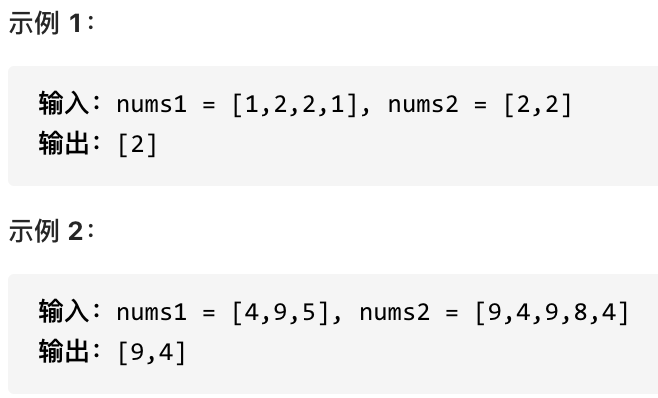
说明:
输出结果中的每个元素一定是唯一的。
我们可以不考虑输出结果的顺序。
算法公开课
《代码随想录》算法视频公开课::,相信结合视频再看本篇题解,更有助于大家对本题的理解。
思路
这道题目,主要要学会使用一种哈希数据结构:unordered_set,这个数据结构可以解决很多类似的问题。
注意题目特意说明:输出结果中的每个元素一定是唯一的,也就是说输出的结果的去重的, 同时可以不考虑输出结果的顺序
这道题用暴力的解法时间复杂度是O(n^2),那来看看使用哈希法进一步优化。
那么用数组来做哈希表也是不错的选择,例如242. 有效的字母异位词
但是要注意,使用数组来做哈希的题目,是因为题目都限制了数值的大小。
而这道题目没有限制数值的大小,就无法使用数组来做哈希表了。
而且如果哈希值比较少、特别分散、跨度非常大,使用数组就造成空间的极大浪费。
此时就要使用另一种结构体了,set ,关于set,C++ 给提供了如下三种可用的数据结构:
- std::set
- std::multiset
- std::unordered_set
std::set和std::multiset底层实现都是红黑树,std::unordered_set的底层实现是哈希表, 使用unordered_set 读写效率是最高的,并不需要对数据进行排序,而且还不要让数据重复,所以选择unordered_set。
思路如图所示:
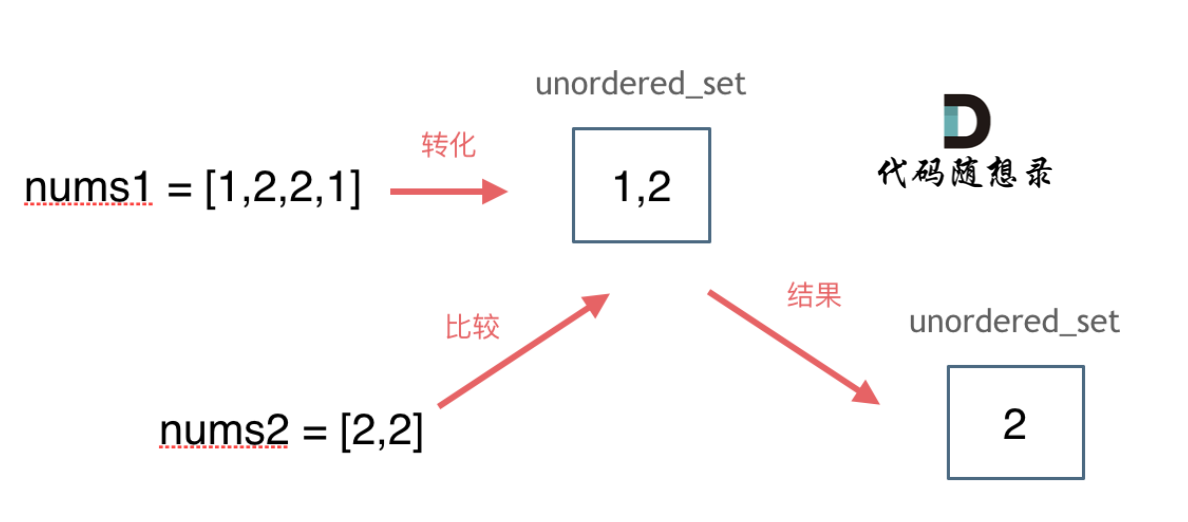
C++代码如下:
class Solution { public: vector<int> intersection(vector<int>& nums1, vector<int>& nums2) { unordered_set<int> result_set; // 存放结果,之所以用set是为了给结果集去重 unordered_set<int> nums_set(nums1.begin(), nums1.end()); for (int num : nums2) { // 发现nums2的元素 在nums_set里又出现过 if (nums_set.find(num) != nums_set.end()) { result_set.insert(num); } } return vector<int>(result_set.begin(), result_set.end()); } };
- 时间复杂度: O(n + m) m 是最后要把 set转成vector
- 空间复杂度: O(n)
拓展
那有同学可能问了,遇到哈希问题我直接都用set不就得了,用什么数组啊。
直接使用set 不仅占用空间比数组大,而且速度要比数组慢,set把数值映射到key上都要做hash计算的。
不要小瞧 这个耗时,在数据量大的情况,差距是很明显的。
后记
本题后面 力扣改了 题目描述 和 后台测试数据,增添了 数值范围:
- 1 <= nums1.length, nums2.length <= 1000
- 0 <= nums1[i], nums2[i] <= 1000
所以就可以 使用数组来做哈希表了, 因为数组都是 1000以内的。
对应C++代码如下:
class Solution { public: vector<int> intersection(vector<int>& nums1, vector<int>& nums2) { unordered_set<int> result_set; // 存放结果,之所以用set是为了给结果集去重 int hash[1005] = {0}; // 默认数值为0 for (int num : nums1) { // nums1中出现的字母在hash数组中做记录 hash[num] = 1; } for (int num : nums2) { // nums2中出现话,result记录 if (hash[num] == 1) { result_set.insert(num); } } return vector<int>(result_set.begin(), result_set.end()); } };
- 时间复杂度: O(m + n)
- 空间复杂度: O(n)
其他语言版本
Java:
版本一:使用HashSet
import java.util.HashSet; import java.util.Set; class Solution { public int[] intersection(int[] nums1, int[] nums2) { if (nums1 == null || nums1.length == 0 || nums2 == null || nums2.length == 0) { return new int[0]; } Set<Integer> set1 = new HashSet<>(); Set<Integer> resSet = new HashSet<>(); //遍历数组1 for (int i : nums1) { set1.add(i); } //遍历数组2的过程中判断哈希表中是否存在该元素 for (int i : nums2) { if (set1.contains(i)) { resSet.add(i); } } //方法1:将结果集合转为数组 return resSet.stream().mapToInt(x -> x).toArray(); //方法2:另外申请一个数组存放setRes中的元素,最后返回数组 int[] arr = new int[resSet.size()]; int j = 0; for(int i : resSet){ arr[j++] = i; } return arr; } }
版本二:使用Hash數組
class Solution { public int[] intersection(int[] nums1, int[] nums2) { int[] hash1 = new int[1002]; int[] hash2 = new int[1002]; for(int i : nums1) hash1[i]++; for(int i : nums2) hash2[i]++; List<Integer> resList = new ArrayList<>(); for(int i = 0; i < 1002; i++) if(hash1[i] > 0 && hash2[i] > 0) resList.add(i); int index = 0; int res[] = new int[resList.size()]; for(int i : resList) res[index++] = i; return res; } }
Python3:
(版本一) 使用字典和集合
class Solution: def intersection(self, nums1: List[int], nums2: List[int]) -> List[int]: # 使用哈希表存储一个数组中的所有元素 table = {} for num in nums1: table[num] = table.get(num, 0) + 1 # 使用集合存储结果 res = set() for num in nums2: if num in table: res.add(num) del table[num] return list(res)
(版本二) 使用数组
class Solution: def intersection(self, nums1: List[int], nums2: List[int]) -> List[int]: count1 = [0]*1001 count2 = [0]*1001 result = [] for i in range(len(nums1)): count1[nums1[i]]+=1 for j in range(len(nums2)): count2[nums2[j]]+=1 for k in range(1001): if count1[k]*count2[k]>0: result.append(k) return result
(版本三) 使用集合
class Solution: def intersection(self, nums1: List[int], nums2: List[int]) -> List[int]: return list(set(nums1) & set(nums2))
Go:
(版本一)使用字典和集合
func intersection(nums1 []int, nums2 []int) []int { set:=make(map[int]struct{},0) // 用map模拟set res:=make([]int,0) for _,v:=range nums1{ if _,ok:=set[v];!ok{ set[v]=struct{}{} } } for _,v:=range nums2{ //如果存在于上一个数组中,则加入结果集,并清空该set值 if _,ok:=set[v];ok{ res=append(res,v) delete(set, v) } } return res }
(版本二)使用数组
func intersection(nums1 []int, nums2 []int) []int { count1 := make([]int, 1001, 1001) count2 := make([]int, 1001, 1001) res := make([]int, 0) for _, v := range nums1 { count1[v] = 1 } for _, v := range nums2 { count2[v] = 1 } for i := 0; i <= 1000; i++ { if count1[i] + count2[i] == 2 { res = append(res, i) } } return res }
JavaScript:
/** * @param {number[]} nums1 * @param {number[]} nums2 * @return {number[]} */ var intersection = function(nums1, nums2) { // 根据数组大小交换操作的数组 if(nums1.length < nums2.length) { const _ = nums1; nums1 = nums2; nums2 = _; } const nums1Set = new Set(nums1); const resSet = new Set(); // for(const n of nums2) { // nums1Set.has(n) && resSet.add(n); // } // 循环 比 迭代器快 for(let i = nums2.length - 1; i >= 0; i--) { nums1Set.has(nums2[i]) && resSet.add(nums2[i]); } return Array.from(resSet); };
TypeScript:
版本一(正常解法):
function intersection(nums1: number[], nums2: number[]): number[] { let resSet: Set<number> = new Set(), nums1Set: Set<number> = new Set(nums1); for (let i of nums2) { if (nums1Set.has(i)) { resSet.add(i); } } return Array.from(resSet); };
版本二(秀操作):
function intersection(nums1: number[], nums2: number[]): number[] { return Array.from(new Set(nums1.filter(i => nums2.includes(i)))) };
Swift:
func intersection(_ nums1: [Int], _ nums2: [Int]) -> [Int] { var set1 = Set<Int>() var set2 = Set<Int>() for num in nums1 { set1.insert(num) } for num in nums2 { if set1.contains(num) { set2.insert(num) } } return Array(set2) }
PHP:
class Solution { /** * @param Integer[] $nums1 * @param Integer[] $nums2 * @return Integer[] */ function intersection($nums1, $nums2) { if (count($nums1) == 0 || count($nums2) == 0) { return []; } $counts = []; $res = []; foreach ($nums1 as $num) { $counts[$num] = 1; } foreach ($nums2 as $num) { if (isset($counts[$num])) { $res[] = $num; } unset($counts[$num]); } return $res; } }
Rust:
use std::collections::HashSet; impl Solution { pub fn intersection(nums1: Vec<i32>, nums2: Vec<i32>) -> Vec<i32> { let mut resultSet: HashSet<i32> = HashSet::with_capacity(1000); let nums1Set: HashSet<i32> = nums1.into_iter().collect(); for num in nums2.iter() { if nums1Set.contains(num) { resultSet.insert(*num); } } let ret: Vec<i32> = resultSet.into_iter().collect(); ret } }
解法2:
use std::collections::HashSet; impl Solution { pub fn intersection(nums1: Vec<i32>, nums2: Vec<i32>) -> Vec<i32> { nums1 .into_iter() .collect::<HashSet<_>>() .intersection(&nums2.into_iter().collect::<HashSet<_>>()) .copied() .collect() } }
C:
int* intersection1(int* nums1, int nums1Size, int* nums2, int nums2Size, int* returnSize){ int nums1Cnt[1000] = {0}; int lessSize = nums1Size < nums2Size ? nums1Size : nums2Size; int * result = (int *) calloc(lessSize, sizeof(int)); int resultIndex = 0; int* tempNums; int i; /* Calculate the number's counts for nums1 array */ for(i = 0; i < nums1Size; i ++) { nums1Cnt[nums1[i]]++; } /* Check if the value in nums2 is existing in nums1 count array */ for(i = 0; i < nums2Size; i ++) { if(nums1Cnt[nums2[i]] > 0) { result[resultIndex] = nums2[i]; resultIndex ++; /* Clear this count to avoid duplicated value */ nums1Cnt[nums2[i]] = 0; } } * returnSize = resultIndex; return result; }
Scala:
正常解法:
object Solution { def intersection(nums1: Array[Int], nums2: Array[Int]): Array[Int] = { // 导入mutable import scala.collection.mutable // 临时Set,用于记录数组1出现的每个元素 val tmpSet: mutable.HashSet[Int] = new mutable.HashSet[Int]() // 结果Set,存储最终结果 val resSet: mutable.HashSet[Int] = new mutable.HashSet[Int]() // 遍历nums1,把每个元素添加到tmpSet nums1.foreach(tmpSet.add(_)) // 遍历nums2,如果在tmpSet存在就添加到resSet nums2.foreach(elem => { if (tmpSet.contains(elem)) { resSet.add(elem) } }) // 将结果转换为Array返回,return可以省略 resSet.toArray } }
骚操作1:
object Solution { def intersection(nums1: Array[Int], nums2: Array[Int]): Array[Int] = { // 先转为Set,然后取交集,最后转换为Array (nums1.toSet).intersect(nums2.toSet).toArray } }
骚操作2:
object Solution { def intersection(nums1: Array[Int], nums2: Array[Int]): Array[Int] = { // distinct去重,然后取交集 (nums1.distinct).intersect(nums2.distinct) } }
C#:
public int[] Intersection(int[] nums1, int[] nums2) { if(nums1==null||nums1.Length==0||nums2==null||nums1.Length==0) return new int[0]; //注意数组条件 HashSet<int> one = Insert(nums1); HashSet<int> two = Insert(nums2); one.IntersectWith(two); return one.ToArray(); } public HashSet<int> Insert(int[] nums){ HashSet<int> one = new HashSet<int>(); foreach(int num in nums){ one.Add(num); } return one; }
Ruby:
def intersection(nums1, nums2) hash = {} result = {} nums1.each do |num| hash[num] = 1 if hash[num].nil? end nums2.each do |num| #取nums1和nums2交集 result[num] = 1 if hash[num] != nil end return result.keys end
相关题目
