Vyper入门:18.raw_call
文档摘要
Vyper 入门: 18. rawcall 在 Vyper 中, 是一种低级的函数调用方式,它提供了直接与以太坊虚拟机(EVM)交互的能力 它可以调用合约地址,并将字节字符串数据发送给该地址 的返回值是一个字节数组,表示被调用的函数的返回数据 本节中我们介绍 的三种用法: 普通调用: 用于执行一个普通的函数调用,可以更改合约的状态 代理/委托调用: 调用另一个合约的函数,但在当前合约的上下文中执行,通过 参数实现 静态调用: 进行只读 调用,不改变合约状态,通过 参数实现 基础语法 参数详解 : 目标合约的地址 : ABI 编码的函数调用数据 (可选): 调用返回的字节数组的最大长度,实际返回的数据如果超出,则只返回此长度 (可选): 自定义 , 默认为 (可选): 随调用发送的 ETH
Vyper 入门: 18. raw_call
在 Vyper 中,raw_call 是一种低级的函数调用方式,它提供了直接与以太坊虚拟机(EVM)交互的能力
- 它可以调用合约地址,并将字节字符串数据发送给该地址
raw_call的返回值是一个字节数组,表示被调用的函数的返回数据
本节中我们介绍 raw_call 的三种用法:
- 普通调用: 用于执行一个普通的函数调用,可以更改合约的状态
- 代理/委托调用: 调用另一个合约的函数,但在当前合约的上下文中执行,通过
is_delegate_call参数实现 - 静态调用: 进行只读
view/pure调用,不改变合约状态,通过is_static_call参数实现
raw_call 基础语法
raw_call(to, data, value)
raw_call 参数详解
to: 目标合约的地址data: ABI 编码的函数调用数据max_outsize(可选): 调用返回的字节数组的最大长度,实际返回的数据如果超出,则只返回此长度gas(可选): 自定义gas, 默认为msg.gasvalue(可选): 随调用发送的 ETH 数量is_delegate_call(可选): 指定是否执行代理/委托调用is_static_call(可选): 指定是否执行静态调用revert_on_failure(可选): 指定是否返回调用success结果,如果为True,调用失败将抛出revert,默认为True
首先部署一个目标合约
目标合约中包含两个调用函数 test_add 和 test_sub 进行数学运算,函数返回运算结果。
一个用于接收 ETH 的函数
代码示例:
# @version 0.3.9 x: public(uint256) y: public(uint256) sender: public(address) @external def test_add(_x: uint256, _y: uint256) -> uint256: self.sender = msg.sender return _x + _y @external def test_sub(_x: uint256, _y: uint256) -> uint256: self.sender = msg.sender return _x - _y @external def update_x(_x: uint256): self.x = _x @external def update_y(_y: uint256): self.y = _y @payable @external def receive_eth(): pass
1. 普通调用
用于发送数据到合约,并执行合约代码
代码示例:
# @version 0.3.9 target: public(address) add_num: public(uint256) sub_num: public(uint256) @external def __init__(_target: address): self.target = _target @external def raw_call_test_add(_x: uint256, _y: uint256): response: Bytes[32] = raw_call( self.target, _abi_encode( _x, # 第一个参数 _y, # 第二个参数 method_id=method_id("test_add(uint256,uint256)") # 调用的函数签名 ), max_outsize=32 ) # 将返回的字节数组转化成整型 self.add_num = convert(response, uint256) @external def raw_call_test_sub(_x: uint256, _y: uint256): success: bool = False response: Bytes[32] = b"" success, response = raw_call( self.target, concat( method_id("test_sub(uint256,uint256)"), # 函数签名 convert(_x, bytes32), # 第一个参数 convert(_y, bytes32) # 第二个参数 ), max_outsize=32, gas=100000, value=0, revert_on_failure=False ) assert success self.sub_num = convert(response, uint256)
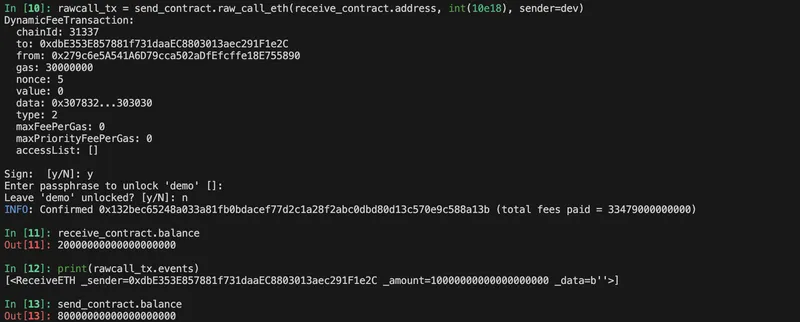
示例代码中对于 data 的构建使用了两种方式,_abi_encode 和 concat,从示例中也能看出 _abi_encode 的使用方式更加简单,在开发过程中根据具体情况选择使用,不过建议优先使用 _abi_encode 进行编码
2. 代理/委托调用
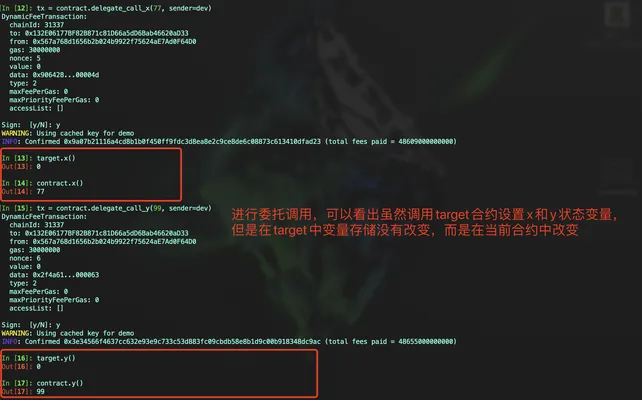
当合约A委托调用合约B时,B的代码将在合约A内部执行,这将更新合约A内的状态变量和以太币余额而不是B,需要注意的是,如果需要改变合约A中的状态变量,那么合约B中的声明的状态变量存储结构必须要和合约A一致
Vyper 中实现委托调用只需要在 raw_call 中添加参数 is_delegate_call=True
示例代码:
x: public(uint256) y: public(uint256) @external def delegate_call_x(_x: uint256): raw_call( self.target, _abi_encode( _x, method_id=method_id("update_x(uint256)") ), is_delegate_call=True ) @external def delegate_call_y(_y: uint256): raw_call( self.target, _abi_encode( _y, method_id=method_id("update_y(uint256)") ), is_delegate_call=True )
代理/委托调用常用于创建可升级的代理合约
什么是代理合约?
代理合约(Proxy contract): 将智能合约的存储合约和逻辑合约分开:代理合约存储所有相关的变量,并且保存逻辑合约的地址;所有函数存在逻辑合约(Logic Contract)里,通过 delegatecall 执行。当升级时,只需要将代理合约指向新的逻辑合约即可。
代理合约示例:VyperProxy
逻辑合约示例:Implementation
3. 静态调用
只能读取数据,不能进行状态变更,适用于查询其他合约的状态
Vyper 中实现静态调用只需要在 raw_call 中添加参数 is_static_call=True
代码示例:
@view @external def get_sender() -> address: response: Bytes[32] = raw_call( self.target, method_id("sender()"), max_outsize=32, is_static_call=True ) return extract32(response, 0, output_type=address)

总结
本节中我们介绍了 raw_call 的 3 种用法及其各个参数的含义,使用时,确保与已知和可信的合约交互