SGLangScheduler技术变迁
文档摘要
SGLang Scheduler 技术变迁 English version | 简体中文 关于作者:我是刘芷溢,电子科技大学计算机本硕研二(27 毕业),目前在找推理加速方向的实习,欢迎联系我!tomlzy213@gmail.com 最开始的 Scheduler 中 CPU 和 GPU 是串行的,导致 GPU 的大量空闲 后面的 Scheduler 允许 CPU 和 GPU overlap,实现了 zero overhead scheduler Scheduler 整体的工作流程如下图所示:[^code-walk] 我们将结合代码分析一下整个 Scheduler 的流程。
SGLang Scheduler 技术变迁
English version | 简体中文
关于作者:我是刘芷溢,电子科技大学计算机本硕研二(27 毕业),目前在找推理加速方向的实习,欢迎联系我!tomlzy213@gmail.com
- 最开始的 Scheduler 中 CPU 和 GPU 是串行的,导致 GPU 的大量空闲
- 后面的 Scheduler 允许 CPU 和 GPU overlap,实现了 zero overhead scheduler
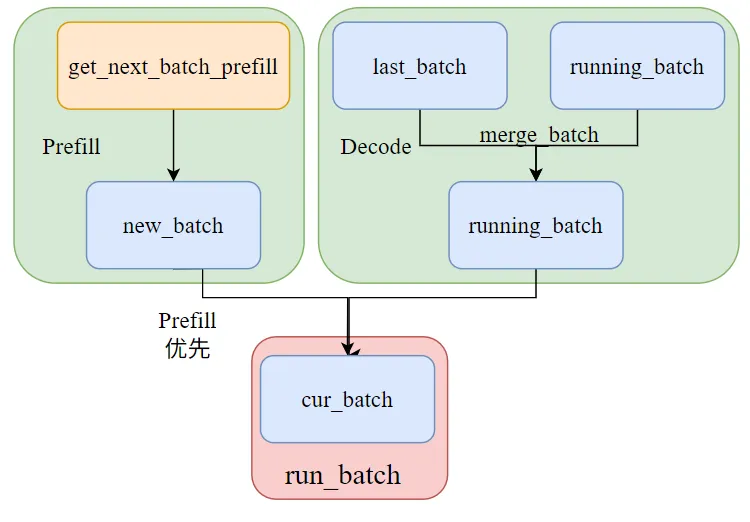
Scheduler 整体的工作流程如下图所示:3

我们将结合代码分析一下整个 Scheduler 的流程。但在分析整个流程之前,我们需要先了解一下调度中比较重要的数据结构以及这些结构之间的关系如何转换
Key Structure
Scheduler
Scheduler 组件负责管理 Active Request。以下核心全局状态用于在 Scheduler 中维护这些 Active Request。
waiting_queue:
- 用途:
waiting_queue是一个数据结构,设计用于存放 Active Request。它根据优先级(Request 的最长前缀)或可用内存动态重新排序这些 Request,以优化批处理任务。 - 一些额外要点
- 入队
- 新到达的 Request。
- 从
retract_decode返回的 Request。
- 出队 当前有最高优先级的 Request 从队列中出队以形成 batch。
- 入队
new_batch:
- 用途::一批准备好进行 prefill/extend 阶段的 Request。
- 一些额外要点
- 分块预填充:如果 Request 所需的 token 数超过可用内存(
remaining_tokens),可能会被分块成较小的部分。 new_batch中的 Request 将经历 prefill/extend。- prefill/extend 后,
new_batch将过渡到 全局批次(Global Batch),用于下一次迭代。
- 分块预填充:如果 Request 所需的 token 数超过可用内存(
running_batch:
- 用途::一批准备好进行 decode 阶段的 Request。
- 初始化为空批次:
ScheduleBatch(reqs=[], batch_is_full=False) - 可以动态添加新完成 prefill 的请求
- 可以移除已完成的请求
- 初始化为空批次:
- 一些额外要点
- Retracted:如果 decode 期间可用内存不足,
Scheduler可能会通过retract_decode从running_batch中撤回某些 Request,将其返回到waiting_queue以供后续处理。
- Retracted:如果 decode 期间可用内存不足,
cur_batch:
- 用途::
Scheduler主循环(run_batch函数)中当前正在处理的 Request 批次。prefill优先 - 一些额外要点
cur_batch在event_loop_normal中分配。- 形成
cur_batch的逻辑是:- 如果本轮有准备好 prefill 的 Request(
new_batch),则使用new_batch作为cur_batch。 - 否则,
cur_batch将处理准备好 decode 的 Request,因此使用running_batch作为cur_batch。
- 如果本轮有准备好 prefill 的 Request(
三个重要的 Batch
Overview:
- ScheduleBatch 由 schedule.py::Scheduler 管理。它包含高级调度数据,大部分数据位于 CPU 上。
- ModelWorkerBatch 由 tp_worker.py::TpModelWorker 管理。它是 ScheduleBatch 的子集,只包含与 GPU 上模型 forward 相关的数据,它将从 CPU scheduler 转换到 GPU model runner。
- ForwardBatch 由 model_runner.py::ModelRunner 管理,它包含低级 tensor 数据
ScheduleBatch:
class ScheduleBatch: reqs: List[Req] # 请求列表 req_to_token_pool: ReqToTokenPool # 请求到token的映射池 token_to_kv_pool_allocator: BaseTokenToKVPoolAllocator # KV缓存分配器 tree_cache: BasePrefixCache # 前缀缓存树 forward_mode: ForwardMode # 前向模式 # 批处理相关 input_ids: torch.Tensor # 输入token IDs seq_lens: torch.Tensor # 序列长度 extend_lens: List[int] # 扩展长度(seq_len - prefix_len) prefix_lens: List[int] # 前缀长度
ModelWorkerBatch:
class ModelWorkerBatch: forward_mode: ForwardMode input_ids: torch.Tensor # 输入token IDs req_pool_indices: torch.Tensor # req 对应的 out_cache_loc 的索引 seq_lens: torch.Tensor # 序列长度 out_cache_loc: torch.Tensor # 分配的 KV cache # 扩展相关(seq - prefix) extend_num_tokens: Optional[int] extend_seq_lens: Optional[List[int]] extend_prefix_lens: Optional[List[int]]
ForwardBatch:
class ForwardBatch: forward_mode: ForwardMode batch_size: int input_ids: torch.Tensor seq_lens: torch.Tensor positions: torch.Tensor # 位置编码 # 注意力相关 attn_backend: AttentionBackend token_to_kv_pool: KVCache # 扩展信息(seq - prefix) extend_num_tokens: Optional[int] extend_start_loc: Optional[torch.Tensor] extend_prefix_lens: Optional[torch.Tensor]
Batch Transformation:
# 1. Scheduler创建ScheduleBatch def run_batch(self, batch: ScheduleBatch): # 2. 转换为ModelWorkerBatch model_worker_batch = batch.get_model_worker_batch() # 3. TpModelWorker处理 def forward_batch_generation(self, model_worker_batch: ModelWorkerBatch): # 4. 转换为ForwardBatch forward_batch = ForwardBatch.init_new(model_worker_batch, self.model_runner) # 5. ModelRunner执行前向传播 logits_output, can_run_cuda_graph = self.model_runner.forward(forward_batch) # 6. 采样生成token next_token_ids = self.model_runner.sample(logits_output, forward_batch) return GenerationBatchResult( logits_output=logits_output, next_token_ids=next_token_ids, can_run_cuda_graph=can_run_cuda_graph, )
Cache
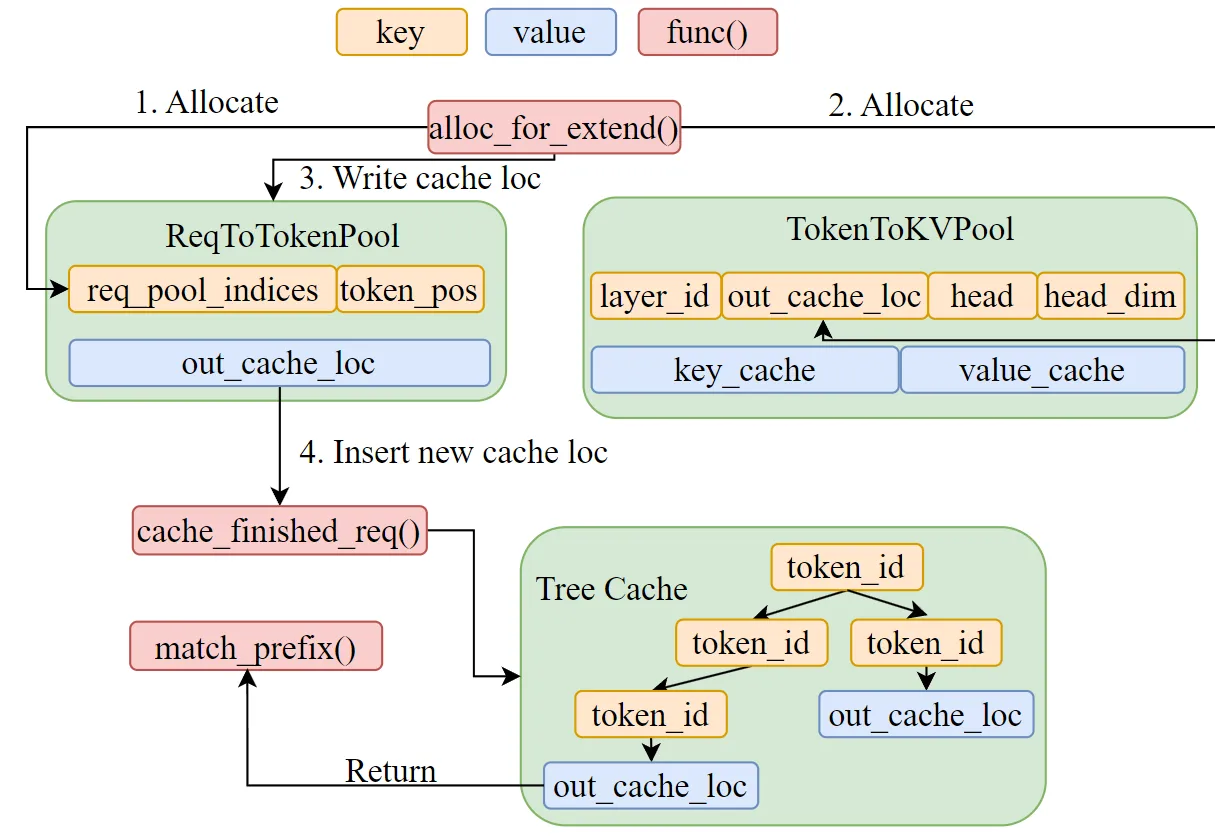
cache 在 sglang 中,相关的主要是``req_to_token_pool, token_to_kv_pool,tree_cache` 三个结构。
req_to_token_pool[req_idx]: ┌─────────────────────────────────────────────────────────────┐ │ 前缀部分 (1984 tokens) │ 新chunk部分 (2000 tokens) │ ├─────────────────────────────────────────────────────────────┤ │ [loc_1, loc_2, ..., loc_1984] │ [loc_1985, ..., loc_3984] │ └─────────────────────────────────────────────────────────────┘ 位置: 0 1984 3984 KV Cache Pool: ┌──────┬──────┬──────┬──────┬──────┬──────┬──────┬──────┐ │loc_1 │loc_2 │ ... │loc_1984│loc_1985│ ... │loc_3984│ ... │ ├──────┼──────┼──────┼──────┼──────┼──────┼──────┼──────┤ │ k1,v1│ k2,v2│ ... │k1984,v1984│k1985,v1985│ ... │k3984,v3984│ ... │ └──────┴──────┴──────┴──────┴──────┴──────┴──────┴──────┘
ReqToTokenPool:
- 管理 req_idx 到 token 位置的映射关系
- 为每个请求分配固定的内存槽位
- 维护请求的 token 序列在内存中的连续布局
class ReqToTokenPool: def __init__(self, size: int, max_context_len: int, device: str, enable_memory_saver: bool): # 主要存储结构:[请求数量, 最大上下文长度] self.req_to_token = torch.zeros( (size, max_context_len), dtype=torch.int32, device=device ) self.free_slots = list(range(size)) # 可用槽位列表 self.size = size self.max_context_len = max_context_len
token_to_kv_pool:
- 管理物理 KV 缓存的分配和释放
- 处理页对齐的内存分配(如果启用分页)
- 支持不同的分配策略(连续分配、分页分配等)
Tree Cache:
其实是联系两个 pool 的组织结构,scheduler 调度过程中会频繁访问,并为请求分配 req_to_token_pool 和 token_to_kv_pool 中的 slot
-
tree_cache 在调度策略中是个关键角色,根据 prefix match 的情况,会决定当前请求何时被 prefill
-
page_size决定前缀匹配的粒度,键匹配策略以及分页匹配算法-
page_size = 1 是逐 token 精确匹配,可以匹配任意长度的前缀
-
page_size > 1 是按页进行前缀匹配(使用 tuple(tokens) 为 key)
# page_size = 1 root └── 1 (child_key=1) └── 2 (child_key=2) └── 3 (child_key=3) └── 4 (child_key=4) └── 5 (child_key=5) # page_size = 4 root └── (1,2,3,4) (child_key=(1,2,3,4)) └── (5,6,7,8) (child_key=(5,6,7,8))
-
RelationShip:
一个新请求进入
- 首先进行最长前缀匹配找到对应的 KV 索引
req_to_token_pool分配extend_token的空闲槽位,得到req_pool_idx索引token_to_kv_pool_allocator分配新的 KV Cache- 更新
req_pool_idx与 KV Cache 间的映射关系
# 直接分配这一个 batch 所有 req 的 extend tokens 需要的 kv cache out_cache_loc = alloc_token_slots(batch.tree_cache, batch.extend_num_tokens) # update 映射(prefix + extend) req_to_token_pool.write( (req_idx, slice(0, prefix_len)), prefix_tensors[i], ) req_to_token_pool.write( (req_idx, slice(prefix_len, seq_len)), out_cache_loc[pt : pt + extend_len], )
PrefillAdder
是 SGLang Scheduler 中负责智能批处理预填充和解码请求的核心组件。它的主要作用是从等待队列中选择合适的请求,组装成一个可以高效执行的预填充批次
如果启用了 Mixed Chunk,可以在一个 batch 中同时包含 prefill 和 decode 请求
class PrefillAdder: def __init__(self, ...): self.page_size = page_size # memory page size self.tree_cache = tree_cache # radix kv cache self.token_to_kv_pool_allocator = token_to_kv_pool_allocator # kv cache pool self.running_batch = running_batch # currently running decode batch self.new_token_ratio = new_token_ratio # new token generation ratio self.can_run_list = [] # list of runnable requests self.preempt_list = [] # list of preempted requests self.new_chunked_req = None # new chunked request self.log_hit_tokens = 0 # number of cache hit tokens self.log_input_tokens = 0 # input token statistics @property def rem_total_tokens(self): """Calculate total remaining available tokens""" def add_one_req(self, req: Req, has_chunked_req: bool, truncation_align_size: Optional[int]): """Add a request to the batch""" def add_chunked_req(self, req: Req): """Handle chunked prefill request""" def preempt_to_schedule(self, req: Req, server_args: ServerArgs) -> bool: """Preempt low-priority requests to make way for high-priority ones"""
GenerationBatchResult
logits_output: Optional[LogitsProcessorOutput]
- 作用: 包含模型前向传播的完整 logits 输出和相关信息
- 内容:
- next_token_logits: 下一个 token 的 logits 分布
[batch_size, vocab_size] - input_token_logprobs: 输入 token 的 log 概率
- hidden_states: 隐藏状态(用于推测解码)
- 各种 top-k logprobs 和 token 概率信息
- next_token_logits: 下一个 token 的 logits 分布
- 用途: 用于采样、计算概率、返回 logprob 信息给用户
next_token_ids: Optional[torch.Tensor]
- 作用: 经过采样后的下一个 token ID
- 形状:
[batch_size] - 内容:
- Prefill 模式:基于最后位置采样的第一个生成 token
- Decode 模式:当前步骤生成的下一个 token
- Prefill-only:全零占位符 tensor
- 用途: 直接用于更新请求的
output_ids,推进生成过程
num_accepted_tokens: Optional[int]
- 作用: 推测解码中被接受的 token 数量
- 用途: 统计推测解码的接受率,用于性能优化和指标收集
next_draft_input: Optional[EagleDraftInput]
- 作用: EAGLE 推测解码的下一轮输入信息
- 内容: 包含 top-k 概率、索引、隐藏状态等
- 用途: 为下一轮推测解码准备输入数据
extend_input_len_per_req: Optional[List[int]]
- 作用: 每个请求的扩展输入长度
- 用途: 在处理 batch 结果时,知道每个请求实际处理了多少个新 token
extend_logprob_start_len_per_req: Optional[List[int]]
- 作用: 每个请求开始计算 logprob 的位置
- 用途: 确定从哪个位置开始返回 logprob 信息给用户
copy_done: Optional[torch.cuda.Event]
- 作用: GPU 到 CPU 数据传输完成的同步事件
- 用途: 在重叠调度中确保数据传输完成再处理结果
delay_sample_func: Optional[callable]
- 作用: 延迟采样函数
- 用途: 在重叠调度中,先执行前向传播,后续再执行采样操作
future_indices: Optional[FutureIndices]
- 作用: Future 机制中的索引信息
- 用途: 在重叠调度中管理异步结果的存储和检索
Normal (No overlap)
LLM 是自回归结构,所以无论是 Prefill 还是 Decode,驱动它们进行下一步推理的都是预测序列的下一个 token,包含 next_token_ids 的数据就非常关键
在 prefill 模式下,next_token_ids 包含的是:
- 形状:
[batch_size]- 每个请求一个 token ID - 内容: 每个序列的下一个 token,即基于输入序列最后一个位置的 logits 采样得到的 token
- 位置: 对于 prefill,只使用序列的最后一个位置进行采样
在 decode 模式下,next_token_ids 包含的是:
- 形状:
[batch_size]- 每个请求一个 token ID - 内容: 每个请求当前解码步骤生成的下一个 token
- 位置: 使用当前解码位置进行采样
Overview
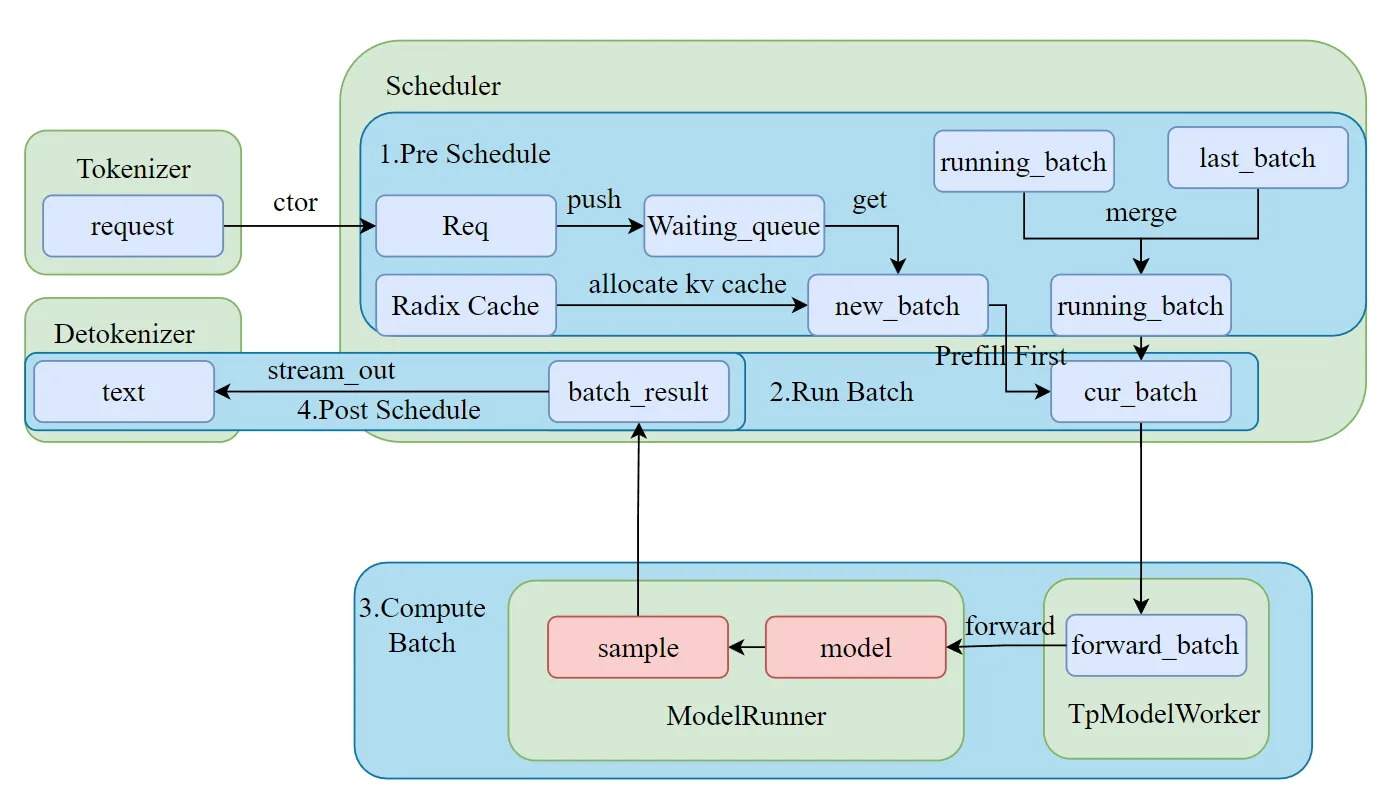
一个请求 Request 进入 SGLang Scheduler,会经过如下阶段
Req -> Pre Schedule(CPU) -> Compute Batch -> Sample(GPU) -> Post Schedule(CPU) -> next Schedule ...
Pre Schedule:
- 收集前端传入的请求,并将其放入等待队列。(
Schedule::recv_request()&Schedule::process_input_requests()) - 从等待队列和 running_batch 中进行调度 (
Schedule::get_batch_to_run())- Prefill 中涉及 Radix Tree 和最长前缀匹配(Longest Prefix Matching)算法。(
Req::init_next_round_input())
- Prefill 中涉及 Radix Tree 和最长前缀匹配(Longest Prefix Matching)算法。(
- 为每个请求分配 Token 所需的内存资源。。(
ScheduleBatch::prepare_for_extend()&ScheduleBatch::prepare_for_decode())
Compute batch:
新的请求会进入 Prefill 阶段,Prefill 阶段结束后进入 Decode 阶
Prefill Schedule:
-
get_next_batch_to_run:这里是 Prefill 优先,所以会调用get_new_batch_prefill,并直接把函数返回的new_batch作为这一轮执行的 batch(即cur_batch) -
get_new_batch_prefill:- 创建 PrefillAdder 来管理批次构建,从 waiting_queue 中选择请求
init_next_round_input更新 radix tree cache 的前缀- 创建新的 ScheduleBatch,调用
prepare_for_extend:- 分配
req_pool_indices:为每个请求在请求池中分配一个唯一的索引位置,这个索引用于在req_to_token_pool中存储该请求的 token-to-KV 映射。- allocate kv cache
- 将 req 与 kv cache 的映射写入到
req_to_token_pool
- 分配
-
run_batch():执行 Decode 推理,调用TpModelWorker::forward_batch_generation()->ModelRunner::forward()->ModelRunner::_forward_raw()->ModelRunner::forward_decode()后面执行 backend 的算子等待返回结果
Decode Schedule:
get_next_batch_to_run():处理上一批次的完成请求,然后与 running_batch 进行 mergeupdate_running_batch():- 调用
prepare_for_decode():- 上一次 schedule 的
output_ids变为这一次的input_ids - 为
out_cache_loc分配(batch size * 1)个 slot,因为在 decode 模式下我们对每个 batch 一次只生成一个 token
out_cache_loc = alloc_token_slots(batch.tree_cache, bs * 1) - 上一次 schedule 的
- 调用
run_batch():执行 Decode 推理,调用TpModelWorker::forward_batch_generation()->ModelRunner::forward()->ModelRunner::_foward_raw()->ModelRunner::forward_decode()后面执行 backend 的算子等待返回结果
Sample:
TpModelWorker::forward_batch_generation():
- 如果不是 overlap 模式,立即进行 Sample,否则重叠 CPU 和 GPU 进行延迟采样
- Sample 得到 batch 的
next_token_ids,供下一次 batch forward 使用sampling_info.update_regex_vocab_mask() sampling_info.apply_logits_bias(logits_output.next_token_logits) next_token_ids = self.sampler( logits_output, forward_batch.sampling_info, forward_batch.return_logprob, forward_batch.top_logprobs_nums, forward_batch.token_ids_logprobs, # For prefill, we only use the position of the last token. ( forward_batch.positions if forward_batch.forward_mode.is_decode() else forward_batch.seq_lens - 1 ), )
Post Schedule:
- Prefill:
process_batch_result_prefill()- 获取结果,调用 tree_cache 的
cache_unfinished_req()保留该 req 的 cache
- 获取结果,调用 tree_cache 的
- Decode:
process_batch_result_decode():- 对每个 Req 进行判断,如果已经完成就释放 tree_cache 中对应的 KV cache(循环解释后批量释放)
- 将 batch 的结果通过
stream_out()返回给 detokenizer 进行下一步处理
事件循环
- 请求都会先执行 prefill 阶段然后执行 decode 阶段,直到获得 EOS 或其他原因退出
def event_loop_normal(self): """A normal scheduler loop.""" while True: recv_reqs = self.recv_requests() self.process_input_requests(recv_reqs) batch = self.get_next_batch_to_run() self.cur_batch = batch if batch: result = self.run_batch(batch) self.process_batch_result(batch, result) else: # When the server is idle, do self-check and re-init some states self.self_check_during_idle() self.last_batch = batch
Pre Schedule
Req -> Waiting_queue:
-
首先执行
recv_requests:- 只有 Pipeline rank = 0 的可以从 zmq 中获取 tokenizer 传来的 requests
- 其他 pipeline rank 从前一个 pipeline 获取 requests
- work_reqs 在 attn_tp 中进行广播;系统的 control_reqs 在整个 tp_size 中广播
-
然后执行
process_input_requests- 提取 worker_id:
worker_id = recv_req.worker_id - 解包请求:
recv_req = recv_req.obj - 分发处理:
output = self._request_dispatcher(recv_req)调用请求分发器- 将 recv_req 构建为新的
Req对象 - 调用
_add_request_to_queue()将Req插入 waiting_queue 中
- 将 recv_req 构建为新的
- 发送回应: 将输出发送回对应的 tokenizer 工作进程
- 提取 worker_id:
Waiting_queue/running_batch -> cur_batch:
获取 prefill batch get_new_batch_prefill():
-
创建 PrefillAdder,对新来的请求进行分块,然后每次处理多个分块
init_next_round_input():- 构建完整填充序列:原始输入 token + 已生成的输出 token
- 最大前缀长度计算:最多缓存到倒数第二个 token(
input_len - 1)模型需要一个输入 Token 来查询(Query)这些缓存的历史信息,并计算出当前步的 Logits(概率分布)。如果我们把所有 Token 都算作 Prefix 并从 Cache 中读取,那么当前步就没有“输入”喂给模型了,模型也就无法计算出 t+1 的 Logits。因此,我们必须 保留最后一个 Token 不放入 Prefix 匹配中,让它作为本次推理的 input_ids 输入给模型。
- 前缀匹配:
- 当 Request
ABC到达时,假设当前 radix cache 里存在一个节点AFG match_prefix会尝试在当前 radix cache 里找到现存的ABC的最长前缀,也就是说它会在AFG节点里找到A- Radix cache 会把这个节点
AFG拆分成A和FG,A节点成为当前 Request 的最后一个节点
- 当 Request
-
创建一个新的 ScheduleBatch
-
调用
ScheduleBatch::prepare_for_extend()-
分配
req_pool_indices为每个请求在请求池中分配一个唯一的索引位置,这个索引用于在req_to_token_pool中存储该请求的 token-to-KV 映射。- allocate kv cache:[每个 Request 的总 input token 数 - match 到的 prefix token 数] 个
out_cache_loc - 将 req 与 kv cache 的映射写入到
req_to_token_pool
req_to_token_pool[req_idx]: ┌─────────────────────────────────────────────────────────────┐ │ 前缀部分 (1984 tokens) │ 新chunk部分 (2000 tokens) │ ├─────────────────────────────────────────────────────────────┤ │ [loc_1, loc_2, ..., loc_1984] │ [loc_1985, ..., loc_3984] │ └─────────────────────────────────────────────────────────────┘ 位置: 0 1984 3984 KV Cache Pool: ┌──────┬──────┬──────┬──────┬──────┬──────┬──────┬──────┐ │loc_1 │loc_2 │ ... │loc_1984│loc_1985│ ... │loc_3984│ ... │ ├──────┼──────┼──────┼──────┼──────┼──────┼──────┼──────┤ │ k1,v1│ k2,v2│ ... │k1984,v1984│k1985,v1985│ ... │k3984,v3984│ ... │ └──────┴──────┴──────┴──────┴──────┴──────┴──────┴──────┘ - allocate kv cache:[每个 Request 的总 input token 数 - match 到的 prefix token 数] 个
-
获取 decode batch:
-
先从 batch 中删除已经完成或者已经出错的 batch,然后将上一轮的 decode batch 与 running_batch 合并
- 实际上就是将
seq_lens,orig_seq_lens,output_ids等进行torch.cat拼接
- 实际上就是将
-
调用
update_running_batch()获取 decode batch-
先检查是否需要回退请求
-
如果需要,把要回退的请求重新插入
waiting_queue,重新排队进行调度 -
调用
ScheduleBatch::prepare_for_decode()- 上一轮输出作为这一轮的输入
- 内存分配 + 序列长度更新
# 假设batch有3个请求,每个请求当前长度分别为[10, 15, 8] # decode需要为每个请求的下一个位置分配空间 # 分配前的KV cache映射 req_to_token_pool[req1_idx, 0:10] = [loc1, loc2, ..., loc10] req_to_token_pool[req2_idx, 0:15] = [loc11, loc12, ..., loc25] req_to_token_pool[req3_idx, 0:8] = [loc26, loc27, ..., loc33] # 执行 alloc_for_decode 后 req_to_token_pool[req1_idx, 10] = loc34 # 为位置10分配 req_to_token_pool[req2_idx, 15] = loc35 # 为位置15分配 req_to_token_pool[req3_idx, 8] = loc36 # 为位置8分配 # out_cache_loc = [loc34, loc35, loc36] # A faster in-place version self.seq_lens.add_(1) self.seq_lens_cpu.add_(1) self.orig_seq_lens.add_(1) # update all length self.seq_lens_sum += bs # bs = batch_size
-
Compute batch & Sample
这里我们暂时只考虑 generation 的情况(还有 Embedding 的情况)
- 将
ScheduleBatch转化为ModelWorkerBatch - 调用
TpModelWorker::forward_batch_generation()- 将
ModelWorkerBatch转化为ForwardBatch - 调用
ModelRunner::forward(),最后调用后端 flashinfer 的算子- Prefill 执行
ModelRunner::forward_extend() - Decode 执行
ModelRunner::forward_decode()
- Prefill 执行
- 立即进行 Sample,根据 logits 获得下一个 token
- 返回结果
GenerationBatchResult
- 将
Post Schedule
Prefill:
- 解包
GenerationBatchResult - 执行
synchronize()等待 GPU→CPU 拷贝完成,保证之后访问的数据已在 CPU 上可用。 - 遍历 batch 中每个请求
- 更新生成结果
- 更新 logprob
- Chunked 请求的特殊处理:
is_chunked > 0表示 prefill 尚未全部完成,需要递减计数并跳过流式输出。
- 输出流式结果:调用
stream_output()将结果(token、logprob 等)发送给客户端(例如 WebSocket / API response)
Decode:
[GPU forward kernel] ↓ (结果写入 GenerationBatchResult) [Scheduler.process_batch_result_decode()] ├── copy_done.synchronize() ├── next_token_ids.tolist() ├── 更新 req 状态 ├── req.output_ids.append(next_token_id) ├── if finished, self.tree_cache.cache_finished_req(req) # 释放 kv cache ├── stream_output() └── free KV pages
Why Overlap?
运行实际调度算法仅占总体调度开销的一小部分。大部分开销来自于模型输入的准备和模型输出的后处理。具体而言,最大的开销来自于构建输入张量(Pre Schedule)、执行输出去标记化(Post Schedule)以及准备每个请求的元数据(Pre Schedule)2
构建模型输入张量和采样元数据方面的开销主要源于 Python
使用多步调度可以降低总体调度开销,但也存在一些弊端。例如,在两次调度调用之间,即使某些请求提前完成,也无法将新的请求添加到批次中。
- vLLM 的 multi-step decode
- SGLang 的 speculative group execution
Zero-Overhead Schedule(Overlap)
原理
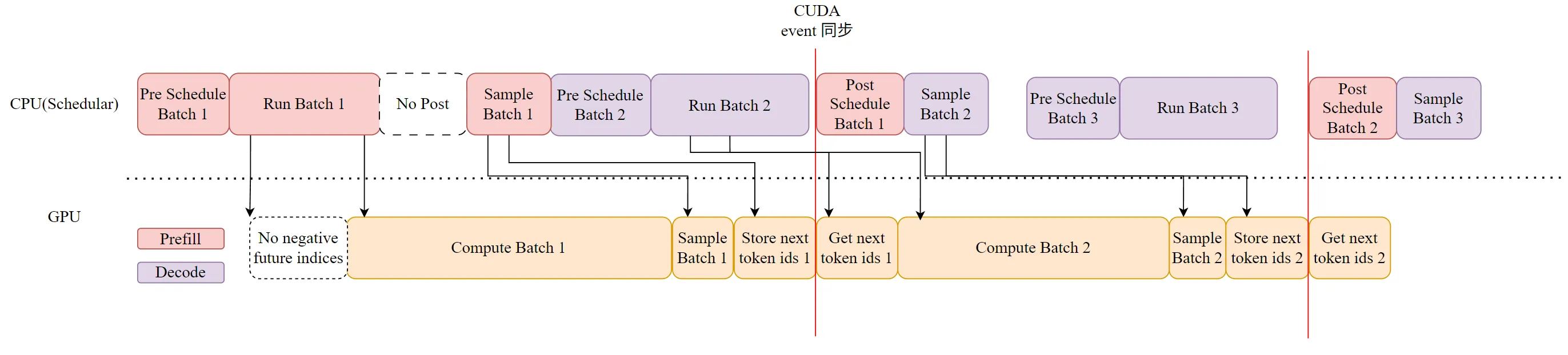
在介绍原理之前我们需要回忆一下上面推理过程的 4 个大步骤,考虑哪些步骤可以进行 Overlap,减少 GPU Bubble,先放一张现在 Overlap 的流水线图
Inference Overview:
SGLang 的推理过程主要分为以下四个阶段:
- Pre schedule:
- 收集前端传入的请求,并将其放入等待队列。(
Scheduler::recv_request()&Scheduler::process_input_requests()) - 从等待队列和 running_batch 中进行调度 (
Scheduler::get_batch_to_run())- Prefill 中涉及 Radix Tree 和最长前缀匹配(Longest Prefix Matching)算法。(
Req::init_next_round_input())
- Prefill 中涉及 Radix Tree 和最长前缀匹配(Longest Prefix Matching)算法。(
- 为每个请求分配 Token 所需的内存资源。(
ScheduleBatch::prepare_for_extend()&ScheduleBatch::prepare_for_decode())
- 收集前端传入的请求,并将其放入等待队列。(
- Compute batch:
- 将 batch 发送到 GPU 上进行一步(即 Continue Batch 的一个 iter)推理(
Scheduler::run_batch())
- 将 batch 发送到 GPU 上进行一步(即 Continue Batch 的一个 iter)推理(
- Sample:
- 根据模型输出的 Logit 进行采样,生成下一步的 Token。(
ModelRunner::sample())
这里我们会应用 grammar 的 vocab mask 来确保采样的合法性,所以这里的采样会依赖模型的输出 Logits
- 根据模型输出的 Logit 进行采样,生成下一步的 Token。(
- Post schedule:
- 在一步推理完成后,动态检查请求是否满足结束条件(Check Finish Condition)。(
Scheduler::process_batch_result()) - 将已完成的请求从批次中移除,并送入 Detokenizer 处理,最终将结果返回给前端。
- 在一步推理完成后,动态检查请求是否满足结束条件(Check Finish Condition)。(
Overlap Overview1:
Compute batch 和 Sample 这两个挨在一起的阶段是 GPU heavy 的,而 schedule 的两个阶段是 CPU heavy 的。当多个 batch 流水线化时,我们可以用 GPU 的 Compute 和 Sample 来重叠上一个 batch 的 post scheduler 与当前 batch 的 pre scheduler。
Prefill 阶段的 Grammar Mask 通常基于 Prompt,不依赖上一次 Decode 的输出,所以这里直接 sample 即可
我们通过使用 CUDA Stream + FutureMap的方式来实现 overlap,具体来说:
- Run Batch 中将两个操作提交到 forward_stream 队列:一个是从 FutureMap 获取上一次 batch 的 next token;一个用这个 token 作为
input_id进行下一次计算 - Sample 中也把两个操作提交到 forward_stream 队列:一个是进行采样;一个是将得到的 next token 写回 FutureMap
- 我们需要注意,采样依赖于在 Post Schedule 阶段准备的词汇表掩码(vocab mask)。因此,我们需要确保前一个批次的 Post Schedule 在执行当前批次的采样之前完成。
- 我们需要在 Post Schedule 处理数据前对 CPU 和 GPU 做一个同步,保证可以处理到 CPU 的
next_token_ids- 我们在 Post Schedule 中进行同步操作,确保后续的处理可以正常运行且不影响 GPU 的流水线工作
def process_batch_result_decode( self: Scheduler, batch: ScheduleBatch, result: GenerationBatchResult, ): if result.copy_done is not None: result.copy_done.synchronize() logits_output, next_token_ids, can_run_cuda_graph = ( result.logits_output, result.next_token_ids, result.can_run_cuda_graph, ) next_token_ids = next_token_ids.tolist() next_token_logprobs = logits_output.next_token_logprobs.tolist()
- 我们在 Post Schedule 中进行同步操作,确保后续的处理可以正常运行且不影响 GPU 的流水线工作
初始化 Overlap
- forward_stream:专门用于 GPU 前向计算,与默认流并行
- copy_stream:处理 GPU->CPU 数据传输
- future_map:管理异步计算结果,使用负索引作为 future 标识符
- 上一个 batch 计算的
output_id作为下一个 batch 的input_id,通过存取future_map实现
- 上一个 batch 计算的
def init_overlap(self): if not self.enable_overlap: return self.forward_stream = torch.cuda.Stream() # GPU前向计算流 # Future映射管理异步结果 self.future_map = FutureMap(max_running_requests, device, spec_algorithm) # batch 缓冲区(防止GPU张量被GC回收) self.batch_record_buf = [None] * 2 self.batch_record_ct = 0
FutureMap:
-
存放在 GPU 上
-
future_ct:当前环形计数器(指针),用于生成新的 future indices(并非“尚未完成的数量”)。 -
future_limit:环形指针的模(用来做% self.future_limit)。代码里用*3的因子来 减小索引冲突概率(防止future_ct快速回绕覆盖尚未写回的 slot)。 -
future_buffer_len:实际缓冲区物理长度(*5),比future_limit更长以保证写入区间有足够空间(防止 slice 越界或回绕写入与读冲突)。 -
这两个因子(3 和 5)是工程经验值,用来增加安全裕量;你可以根据并发量和 outstanding futures 调整。
class FutureMap: def __init__( self, max_running_requests: int, ): self.future_ct = 0 # A factor of 3 is used to avoid collision in the circular buffer. self.future_limit = max_running_requests * 3 # A factor of 5 is used to ensure the buffer is large enough. self.future_buffer_len = max_running_requests * 5
工作流程
-
分配 (Alloc) - CPU 阶段
- 执行
future_indices = self.future_map.alloc_future_indices(bs),得到一组负数索引(例如 [-1, -2, -3]),代表“未来的结果将存放在这里”。 - 这些负数索引会被作为下一个 batch 的
input_ids
- 执行
-
存储 (Store) - GPU 阶段 (Batch N)
- 当 Batch N 在 GPU 上执行 Forward + Sample后,真实的 token ID 已经在 batch 的结果里面了。
- 执行
self.future_map.store_to_map(future_indices, batch_result)把 GPU 显存中刚刚生成的next_token_ids直接拷贝到 FutureMap 对应的缓冲区位置。 - GPU 上完成,不需要回传给 CPU。
-
解析 (Resolve) - GPU 阶段 (Batch N+1)
- 当 Batch N+1 开始在 GPU 上执行 Forward 之前,它需要先把输入数据里的负数 token 换成batch 中真实的 token。
- 执行
self.future_map.resolve_future(model_worker_batch),将input_ids里的负数索引替换成 FutureMap 里对应位置的真实 token ID。 - 因为 GPU 命令是顺序执行的,Batch N 的 Store 一定发生在 Batch N+1 的 Resolve 之前。
Overlap 事件循环
def event_loop_overlap(self): self.result_queue = deque() # 存储(batch, result)对 while True: # === Pre Schedule 2 === recv_reqs = self.recv_requests() self.process_input_requests(recv_reqs) batch = self.get_next_batch_to_run() self.cur_batch = batch batch_result = None if batch: # === Launch Compute Batch 2 === batch_result = self.run_batch(batch) # 非阻塞启动 self.result_queue.append((batch.copy(), batch_result)) # === Post Schedule 1 === # compute batch 2 与 post schedule 1 并行执行 if self.last_batch: # 处理队列中的结果(此时GPU在并行计算当前批次) tmp_batch, tmp_result = self.result_queue.popleft() self.process_batch_result(tmp_batch, tmp_result) elif batch is None: self.self_check_during_idle() # === Launch Sample 2 === self.launch_batch_sample_if_needed(batch_result) # update vocab mask self.last_batch = batch
与 normal event loop 的不同
Schedule::run_batch()Schedule::record_batch_in_overlap():在两个 overlap 的 batch 中交替存储 model_worker_batch 引用,避免在 overlap 的 forward 尚未结束时,CUDA kernel 访问野指针或已释放的显存FutureMap::resolve_future():用上一轮 batch sample 得到的真实 token 替换负索引的占位符
TpModelWorker::forward_batch_generation(),该函数仅仅将model_runner.sample函数 delay 执行,先返回 batch_result- 增加了
Scheduler::launch_batch_sample_if_needed():- 执行真正的 Sample 操作
- 屏蔽非法 token,分配 vocab_mask 张量大小 [batch, vocab_size]
- 移动 mask 到 CPU
- 将得到的
next_token_id存储到 FutureMap 的future_indices的对应位置- 为了下一次 batch 在
run_batch中的resolve_future获取到真正的 token
- 为了下一次 batch 在
- 执行真正的 Sample 操作
依赖 & Solutions
Sample 阶段的 vocab mask 依赖于上一轮的 Post Schedule 阶段
- 通过 CPU 侧调度逻辑保证本轮 Sample 阶段在 上一轮 Post Schedule阶段之后执行
Decode 阶段 Compute batch 阶段依赖于上一轮 batch 的 next token
- 通过 FutureMap 作为桥梁,CPU先填充负索引占位符,GPU 侧在 Sample 阶段存储真实 token,在 Compute batch 阶段获取真实 token
- CUDA Stream 的顺序保证上一轮 Sample 一定在下一轮 Compute 之前完成,不会获取到错误的负数 "token"
# previous batch output is negative indices batch.output_ids = -self.future_map.alloc_future_indices(bs).indices with self.forward_stream_ctx: self.forward_stream.wait_stream(self.default_stream) _batch_result = batch_result.delay_sample_func() assert _batch_result is batch_result # store token to negative indices self.future_map.store_to_map(batch_result.future_indices, batch_result) batch_result.copy_to_cpu() # next batch input is output of previous batch with self.forward_stream_ctx: self.forward_stream.wait_stream(self.default_stream) # get token from negative indices self.future_map._resolve_future_token_ids(model_worker_batch.input_ids, self.token_ids_buf) batch_result = self.model_worker.forward_batch_generation( model_worker_batch )
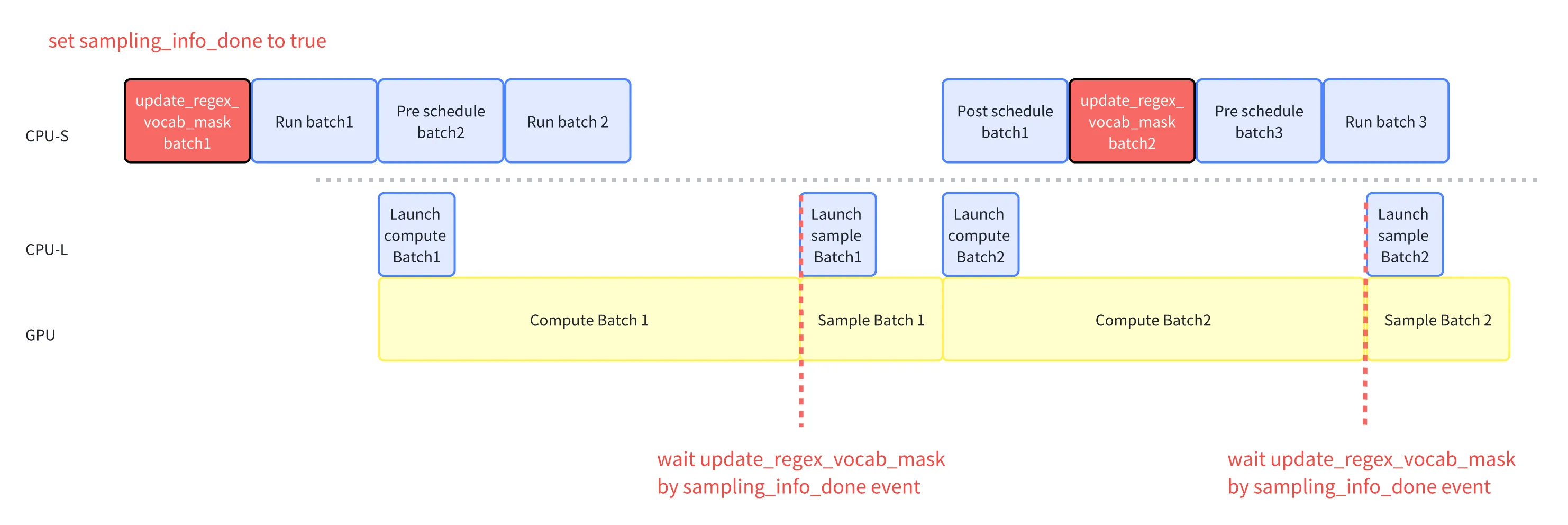
与上一版 overlap 差异
- 将 update_vocab_mask 移动到 GPU 进行计算(在 Sample 中进行),
vocab_mask也在 GPU 直接进行分配,不再进行传输 - 现在的 GPU 额外负责向 FutureMap 存储(after sample)以及获取(before compute)
next_token_ids- FutureMap 也是完全存储在 GPU 上
- 对 GPU 调度由原来 CPU 进行 launch,变成直接将操作提交到 cuda stream,由 stream 自己来调度
- 对 sample 的同步,上一版使用 cuda event 进行同步,这里直接使用 cuda stream 顺序限制来进行同步
两个版本的优缺点
CUDA stream 版本:
- 执行效率更高:
vocab_mask和token_ids_buf无 CPU-GPU 传输;充分利用 GPU 内存带宽 - 延迟更低:
token_ids_buf直接在 GPU 上原地修改,不必反复传输- 与模型推理在同一设备上,便于流水线
- 非模型占用显存大:
token_ids_buf占用 GPU 显存,开销固定
CPU launch 版本:
- 只有在使用时才占用 GPU 内存
- 同步点增加:
vocab_mask会增加一次 CPU-GPU 同步- CPU-GPU 同步会破坏流水线