AgentLoop源码浅析
文档摘要
AgentLoop 源码浅析 最近 RL sys 圈子的吴锡斌老师在 verl 上设计了将 rollout 与 tool 调用解耦的 AgentLoop,实现了自由灵活的 mutli-turn RL。在每个 AgentLoop 内部,rollout engine 只对外提供一个 token-in-token-out 的接口,而 tool 调用则通过 来实现。我个人比较喜欢这样解耦的设计,同时,AgentLoop 的代码结构也比较清晰。我个人学习了一次整个代码后,觉着 AgentLoop 的设计甚是不错,但是 的历史包袱还是很重。 本文简单分析了 agent loop 的源码,并给出了一些自己的看法。 如果我们把整个 当做一个 的话,AgentLoop 里面包装的两层 和 。
AgentLoop 源码浅析
最近 RL sys 圈子的吴锡斌老师在 verl 上设计了将 rollout 与 tool 调用解耦的 AgentLoop,实现了自由灵活的 mutli-turn RL。在每个 AgentLoop 内部,rollout engine 只对外提供一个 token-in-token-out 的接口,而 tool 调用则通过 ToolAgentLoop 来实现。我个人比较喜欢这样解耦的设计,同时,AgentLoop 的代码结构也比较清晰。我个人学习了一次整个代码后,觉着 AgentLoop 的设计甚是不错,但是 ActorRolloutRefWorker 的历史包袱还是很重。
本文简单分析了 agent loop 的源码,并给出了一些自己的看法。
如果我们把整个 ActorRolloutRefWorker 当做一个 sgl.Engine 的话,AgentLoop 里面包装的两层 AsyncSGLangServer 和 AsyncLLMServerManager。AsyncSGLangServer 相当于在 sgl.Engine 上包装了 fastapi 成了 server,而 AsyncLLMServerManager 是在 server 上包了一层 router 做 load balance,相当于 sglang 的 router。这两层设计都是合理的,主要麻烦的是 ActorRolloutRefWorker,层层调用,最后一共经过 7 个 class 才调到 sgl.Engine,最近 verl 团队也在致力于对这块 worker class 的重构,敬请期待。最后,AgentLoopManager,AgentLoopWorker 和 AgentLoop 这三层,我觉得 AgentLoopWorker 可能未必有必要,其他两层挺合理的。
Author
Changyi Yang(CMU), Huapeng Zhou(UW), Chenyang Zhao(LMSYS)
Related Resources
Script
Related PR
https://github.com/volcengine/verl/pull/2124
Design Docs
https://github.com/volcengine/verl/pull/2563
https://github.com/volcengine/verl/pull/A2598
Commit we are looking at
https://github.com/volcengine/verl/tree/c5b189a1af496d0bc68320cd1d5bd7a1f1e3638a
使用 AgentLoop
安装 verl-sglang 的最新版本:
cd ~ git clone https://github.com/volcengine/verl.git cd verl python -m uv pip install wheel setuptools python3 -m uv pip install -e ".[sglang]" --prerelease=allow python3 -m uv pip install -r ./requirements.txt --no-build-isolation python3 -m uv pip install torch_memory_saver
具体实现自己的 agent loop(见下文分析),然后配置 config 文件:
actor_rollout_ref.rollout.mode=async \ actor_rollout_ref.rollout.multi_turn.enable=true \ actor_rollout_ref.rollout.name=sglang \
注意,不使用 actor_rollout_ref.rollout.mode=async 的话,会启用 SGLangRollout 本身管理的 mutli-turn 功能,在效果上和 AgentLoop 完全一致。
最后,在数据集构建过程中添加一个新的 agent_name 字段,比如我们在 ~/verl/examples/data_preprocess/gsm8k_multiturn_w_tool.py 中追加 "agent_name": "tool_agent":
def make_map_fn(split): def process_fn(example, idx): question_raw = example.pop("question") question = question_raw + " " + instruction_following answer_raw = example.pop("answer") solution = extract_solution(answer_raw) data = { "data_source": data_source, # new column for agent loop "agent_name": "tool_agent", "prompt": [ { #... } ] } return data return process_fn
调用总览
main_ppo.py -> RayPPOTrainer(fit)-> AgentLoopManager(async) -> AgentLoopWorker -> AsyncLLMServerManager -> AsyncSGLangServer -> AsyncActorRolloutRefWorker -> SGLangRollout -> AsyncEngine -> sgl.Engine
TaskRunner启动训练,调用RayPPOTrainer.fit()。RayPPOTrainer管理训练流程,调用AgentLoopManager.generate_sequences()开始层层向下调用,同时初始化AsyncActorRolloutRefWorker。AgentLoopManager初始化 dp 个AsyncSGLangServer,随后,初始化num_rollout_workers个AgentLoopWorker。- 接着,每个
AgentLoopWorker根据agent_name从预先注册好的_agent_loop_registry初始化自身管理的train_batch_size / num_rollout_workers个AgentLoop实例,对于 GRPO,train_batch_size需要乘以 group size。用户可以依照自身需求注册新的AgentLoop,目前通过ToolAgentLoop来完全覆盖了SGLangRollout中基于_req_level_generate_sequences实现的 tool call 管理。也就是说, 先前的 multi-turn RL 的 tool 状态管理是在SGLangRollout内实现的,而AgentLoop将这层管理抽象了出来,SGLangRollout只是向上包装为AsyncSGLangServer来完成 token-in-token-out。 AgentLoop初始化后,管理 tool 调用的各种状态,并且根据 policy 的返回情况,向下层层调用AsyncLLMServerManager->AsyncSGLangServer->AsyncActorRolloutRefWorker->SGLangRollout->AsyncEngine->sgl.Engine,得到模型输出。 返回输出后,AgentLoop生命周期结束。AgentLoopWorker收集所有AgentLoop的返回值,上交给AgentLoopManager,等待下一次调用。AgentLoopManager收集所有AgentLoopWorker的返回值,返回。
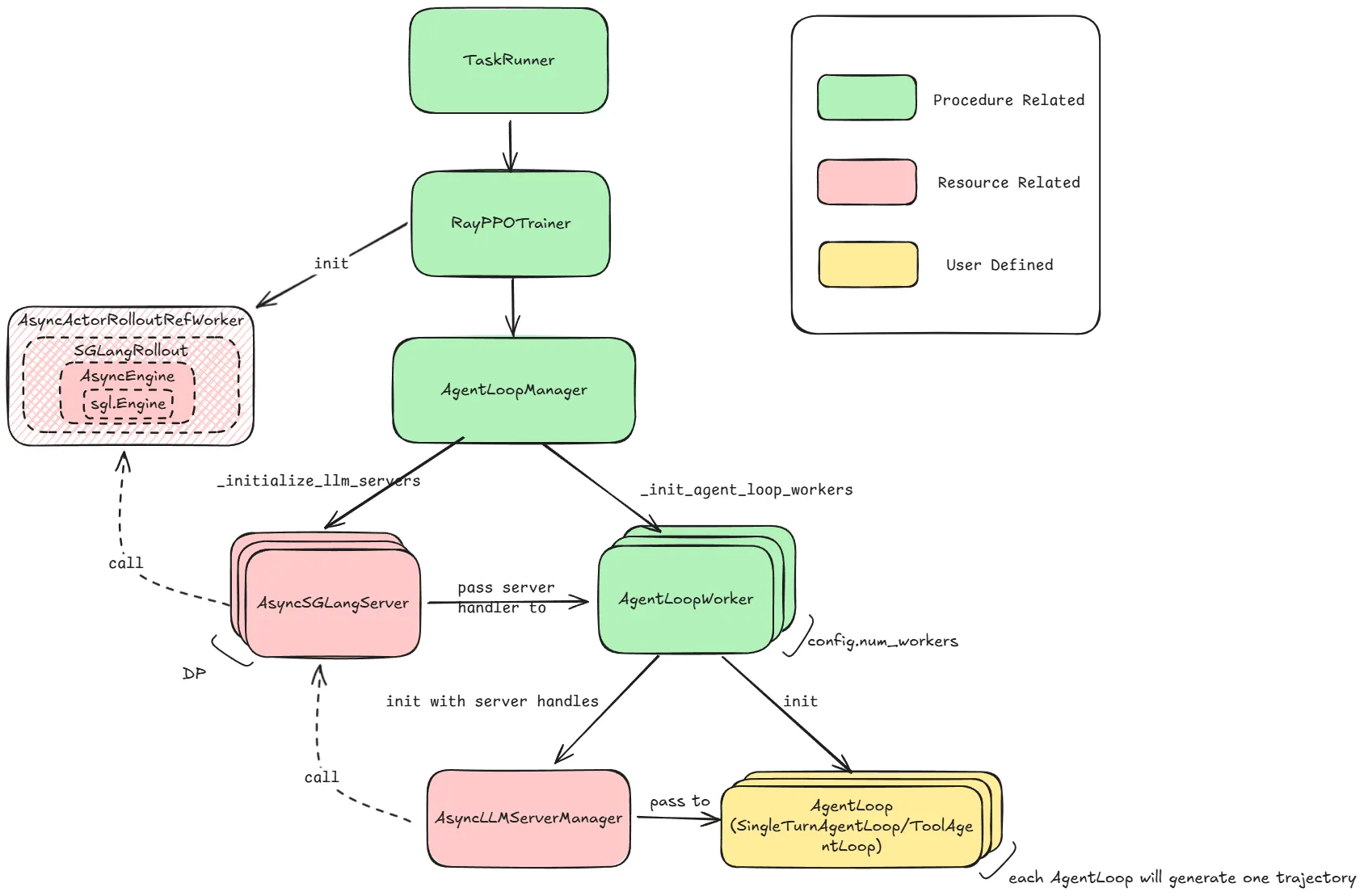
AgentLoopManager
AgentLoop 的最顶层管理者,负责管理 AgentLoopWorker 以及 LLM servers 的生命周期。核心方法是generate_sequences:向下层层调用,得到 policy model 在给定的 agent loop 环境下的 trajectories。
核心 API
在 RayPPOTrainer 中被初始化:
if self.config.actor_rollout_ref.rollout.mode == "async": from verl.experimental.agent_loop import AgentLoopManager self.async_rollout_mode = True self.async_rollout_manager = AgentLoopManager( config=self.config, worker_group=self.actor_rollout_wg, )
具体的初始化非常简洁:
__init__
def __init__(self, config: DictConfig, worker_group: RayWorkerGroup): """Initialize agent loop manager. Args: config (DictConfig): trainer config. worker_group (RayWorkerGroup): ActorRolloutRef worker group. """ self.config = config self.worker_group = worker_group self._initialize_llm_servers() self._init_agent_loop_workers() # Initially we're in sleep mode. self.sleep()
- 传入 ActorRolloutRefWOrker 对应的 worker group,在
_initialize_llm_servers里用来查找对应的 RolloutWorker; - 初始化 llm server 和 agent loop workers;
_initialize_llm_servers
- 计算 dp size:
self.rollout_dp_size = self.worker_group.world_size // self.rollout_tp_size - 通过
async_server_class(rollout_backend=self.config.actor_rollout_ref.rollout.name)获取服务器类,如Async``SGLang``Server,作为和下层的sgl.Engine通信的转接层。 - 用 ray 初始化 dp size 个 server,为每个 dp rank 创建 server 实例。
- 通过
ray.get(server.get_server_address.remote())获取并记录每个服务器的地址 - 调用
ray.get([server.init_engine.remote() for server in self.async_llm_servers]);server 从 ray 通过前缀查询,在已经初始化好的 ray actor 中拿到自己对应的所有 SGLang engine。
def _initialize_llm_servers(self): # 计算 dp size self.rollout_tp_size = self.config.actor_rollout_ref.rollout.tensor_model_parallel_size self.rollout_dp_size = self.worker_group.world_size // self.rollout_tp_size # 获取 worker 信息用于节点亲和性调度 register_center = ray.get_actor(f"{self.worker_group.name_prefix}_register_center") workers_info = ray.get(register_center.get_worker_info.remote()) assert len(workers_info) == self.worker_group.world_size self.async_llm_servers = [None] * self.rollout_dp_size self.server_addresses = [None] * self.rollout_dp_size # 根据 config 拿到对应的 server, e.g., AsyncSGLangServer if self.config.actor_rollout_ref.rollout.agent.custom_async_server: server_class = async_server_class( rollout_backend=self.config.actor_rollout_ref.rollout.name, rollout_backend_module=self.config.actor_rollout_ref.rollout.agent.custom_async_server.path, rollout_backend_class=self.config.actor_rollout_ref.rollout.agent.custom_async_server.name, ) else: server_class = async_server_class(rollout_backend=self.config.actor_rollout_ref.rollout.name) # 用 ray 初始化 dp rank 个 AsyncServer unready_dp_ranks = set(range(self.rollout_dp_size)) while len(unready_dp_ranks) > 0: servers = { rollout_dp_rank: server_class.options( # 确保 AsyncServer 与对应的工作器在同一节点 scheduling_strategy=ray.util.scheduling_strategies.NodeAffinitySchedulingStrategy( node_id=workers_info[rollout_dp_rank * self.rollout_tp_size], soft=False, ), name=f"async_llm_server_{rollout_dp_rank}", ).remote(self.config, self.rollout_dp_size, rollout_dp_rank, self.worker_group.name_prefix) for rollout_dp_rank in unready_dp_ranks } # 记录 server 地址 for rollout_dp_rank, server in servers.items(): try: address = ray.get(server.get_server_address.remote()) self.server_addresses[rollout_dp_rank] = address self.async_llm_servers[rollout_dp_rank] = server unready_dp_ranks.remove(rollout_dp_rank) except Exception: ray.kill(server) print(f"rollout server {rollout_dp_rank} failed, maybe address already in use, restarting...") # 初始化 server,这个初始化是 server 从 ray 中拿到自己 dp 对应的所有 worker ray.get([server.init_engine.remote() for server in self.async_llm_servers])
_init_agent_loop_workers
在 ray 上初始化 rollout.agent.num_workers 个 AgentLoopWorker:
def _init_agent_loop_workers(self): self.agent_loop_workers = [] for i in range(self.config.actor_rollout_ref.rollout.agent.num_workers): self.agent_loop_workers.append( AgentLoopWorker.options( name=f"agent_loop_worker_{i}", ).remote(self.config, self.async_llm_servers) )
generate_sequences
- 如果配置了
free_cache_engine,先调用self.wake_up() chunkes = prompts.chunk(len(self.agent_loop_workers))将输入批次按 AgentLoopWorker 数量分块。- 每个 agentLoopWorker 处理自身的 chunk,通过
ray.get([worker.generate_sequences.remote(chunk) for ...])并行执行并得到结果; - 处理完成后调用
self.sleep()让 server 进入睡眠状态以释放显存 - 计算生成序列和工具调用的性能指标
- 合并所有
AgentLoopWorker的输出并返回
Code link [here]
def generate_sequences(self, prompts: DataProto) -> DataProto: if self.config.actor_rollout_ref.rollout.free_cache_engine: self.wake_up() # 唤醒所有 LLM 服务器 chunkes = prompts.chunk(len(self.agent_loop_workers)) # 按 worker 数量分块 outputs = ray.get( [worker.generate_sequences.remote(chunk) for worker, chunk in zip(self.agent_loop_workers, chunkes)] ) # 并行分发到各个 AgentLoopWorker output = DataProto.concat(outputs) # 聚合所有 worker 的输出 if self.config.actor_rollout_ref.rollout.free_cache_engine: self.sleep() # 让服务器进入睡眠状态,释放显存 # 计算性能指标 metrics = [output.meta_info["metrics"] for output in outputs] timing = self._performance_metrics(metrics, output) output.meta_info = {"timing": timing} return output
AsyncSGLangServer
基于 SGLang 的异步服务器实现,继承自AsyncServerBase。作为 Ray 远程 actor 运行,负责将收到的请求转发给下层的 SGLang Engine。出于 SGLang 的设计,调用 generate 的时候只需要对 master worker(verl 的 inference tp 0)调用即可。
核心 API
init_engine
异步初始化 SGLang 引擎:
- 通过
ray.util.list_named_actors查找所有匹配的 actors; - 根据命名规则
self.wg_prefix + "WorkerDict_"解析 actor 名称; - 根据 dp_rank 和 tp_size 分配 actor,确定 master worker(tp rank 0)
async def init_engine(self): if self.workers: # avoid init twice return all_actors = ray.util.list_named_actors(all_namespaces=True) matched_actors = [ actor for actor in all_actors if actor.get("name", None).startswith(self.wg_prefix + "WorkerDict_") ] gpu_per_node = len(set([actor["name"].split(":")[1] for actor in matched_actors])) # total gpu num assert len(matched_actors) == self._dp_size * self._tp_size for matched_actor in matched_actors: fields = matched_actor["name"].split(":") assert len(fields) == 2, f"invalid actor name: {matched_actor['name']}" pg_index, local_rank = int(fields[0].split("_")[-1]), int(fields[1]) current_global_rank = gpu_per_node * pg_index + local_rank worker_dp_rank = current_global_rank // self._tp_size worker_tp_rank = current_global_rank % self._tp_size if worker_dp_rank == self._dp_rank: worker = ray.get_actor(**matched_actor) self.workers.append(worker) if worker_tp_rank == 0: self.master_worker = worker
chat_completion
处理 chat_completion 请求:
async def chat_completion(self, raw_request: Request): request = await raw_request.json() output_future = self.master_worker.chat_completion.remote(request) [outputs] = await asyncio.gather(output_future) return JSONResponse(outputs)
- 将请求转发给 master worker 处理
- 返回 JSON 格式的响应
generate
Token in token out 来获得 SGLang Engine 的 inference 结果:
async def generate(self, prompt_ids: List[int], sampling_params: Dict[str, Any], request_id: str) -> List[int]: return await self.master_worker.generate.remote(prompt_ids, sampling_params, request_id)
- 直接调用 master worker 的生成方法
- 支持自定义采样参数
AsyncLLMServerManager
管理多个 OpenAI 兼容的 LLM 服务器 (例如 AsyncSGLangServer),提供负载均衡和会话粘性功能。支持最少请求负载均衡算法,确保多轮对话发送到同一服务器以实现自动前缀缓存。可以认为就是简单的 router/load balancer 层。
初始化
- 配置服务器句柄列表,随机打乱顺序
- 初始化最少请求负载均衡器:
self.weighted_serveres = [[0, (hash(server), server)] for server in server_handles] - 创建 LRU 缓存:
self.request_id_to_server = LRUCache(maxsize=max_cache_size)用于 request_id 到服务器的映射
def __init__(self, config: DictConfig, server_handles: List[ray.actor.ActorHandle], max_cache_size: int = 10000): """Initialize the AsyncLLMServerManager. Args: config (DictConfig): YAML config. server_handles (List[ray.actor.ActorHandle]): OpenAI compatible LLM server actor handles. max_cache_size (int, optional): max cache size for request_id to server mapping. Defaults to 10000. """ self.config = config self.server_handles = server_handles random.shuffle(self.server_handles) # Least requests load balancing self.weighted_serveres = [[0, (hash(server), server)] for server in server_handles] heapq.heapify(self.weighted_serveres) # LRU cache to map request_id to server self.request_id_to_server = LRUCache(maxsize=max_cache_size)
_choose_server
def _choose_server(self, request_id: str) -> ray.actor.ActorHandle: if request_id in self.request_id_to_server: return self.request_id_to_server[request_id] # 会话粘性 server = self.weighted_serveres[0][1][1] # 最少请求的服务器 self.weighted_serveres[0][0] += 1 # 增加请求计数 heapq.heapreplace(self.weighted_serveres, self.weighted_serveres[0]) self.request_id_to_server[request_id] = server return server
- 会话粘性:相同
request_id发送给同一server - 最少请求:新请求分配给当前负载最轻的
server - 动态更新:使用堆结构维护服务器负载状态
generate
@rollout_trace_op async def generate(self, request_id, *, prompt_ids: List[int], sampling_params: Dict[str, Any]) -> List[int]: server = self._choose_server(request_id) output = await server.generate.remote( request_id=request_id, prompt_ids=prompt_ids, sampling_params=sampling_params, ) return output
- 根据
request_id选择server - 异步调用 server 的生成接口,token-in-token-out
- 支持性能追踪
AgentLoopWorker
AgentLoopWorker 负责接收数据,向下发给具体的 AgentLoop。虽然名字是 worker,但是
- 从 ray 的角度来说,
AgentLoopWorker是有状态的,是 ray actor,而不是 ray worker - 核心函数
generate是层层套壳,调用其他类;例如single_turn_agent_loop和tool_agent_loop来generate(当然这两个类的generate也是向下调用,下面会讲到)
__init__
@ray.remote class AgentLoopWorker: """Agent loop worker takes a batch of messages and run each message in an agent loop.""" def __init__(self, config: DictConfig, server_handles: list[ray.actor.ActorHandle]): """Initialize agent loop manager. Args: config (DictConfig): YAML config. server_handles (List[ray.actor.ActorHandle]): OpenAI compatible LLM server actor handles. """ self.config = config self.server_manager = AsyncLLMServerManager(config, server_handles) model_path = config.actor_rollout_ref.model.path self.model_name = "/".join(model_path.split("/")[-2:]) local_path = copy_to_local(config.actor_rollout_ref.model.path) self.tokenizer = hf_tokenizer(local_path, trust_remote_code=True) trace_config = self.config.actor_rollout_ref.rollout.get("trace", {}) RolloutTraceConfig.init( self.config.trainer.project_name, self.config.trainer.experiment_name, trace_config.get("backend"), trace_config.get("token2text", False), )
- 上游传过来的
config和server_handles作为参数来初始化AsyncLLMServerManager,之后会把这个self.server_manager传给下游; - 根据
config的config.actor_rollout_ref.model.path设置model_path, local_path, tokenizer - 配置
RolloutTraceConfig用于追踪 trajectories
generate_sequences
async def generate_sequences(self, batch: DataProto) -> DataProto: """Generate sequences from agent loop. Args: batch (DataProto): Input batch. Returns: DataProto: Output batch. - prompts: [bsz, prompt_length], prompt token ids from dataset. - responses: [bsz, response_length], output token ids include response tokens from LLM generation and observation tokens from tool_calls. - response_mask: [bsz, response_length], 1 for LLM generated tokens, 0 for observation/padding tokens. - input_ids: [bsz, prompt_length + response_length], whole sequence token ids, including prompt tokens and response tokens. - attention_mask: [bsz, prompt_length + response_length], 0 for padding tokens, 1 for other tokens. - position_ids: [bsz, prompt_length + response_length], incremental position ids. For multi-turn conversations: responses: |<- LLM generation ->|<- tool_calls ->|<- LLM generation ->|<- padding ->| response_mask: | 1, 1, 1, ..., 1, 1 | 0, 0, .., 0, 0 | 1, 1, 1, ..., 1, 1 | 0, 0, ..., 0| """ config = self.config.actor_rollout_ref.rollout sampling_params = dict( temperature=config.temperature, top_p=config.top_p, repetition_penalty=1.0, ) # override sampling params for validation if batch.meta_info.get("validate", False): sampling_params["top_p"] = config.val_kwargs.top_p sampling_params["temperature"] = config.val_kwargs.temperature # by default, we assume it's a single turn agent if "agent_name" not in batch.non_tensor_batch: batch.non_tensor_batch["agent_name"] = np.array(["single_turn_agent"] * len(batch), dtype=object) tasks = [] agent_names = batch.non_tensor_batch["agent_name"] raw_prompts = batch.non_tensor_batch["raw_prompt"] if "index" in batch.non_tensor_batch: index = batch.non_tensor_batch["index"] else: index = np.arange(len(raw_prompts)) trajectory_info = await get_trajectory_info( batch.meta_info.get("global_steps", -1), index, batch.meta_info.get("validate", False) ) for agent_name, messages, trajectory in zip(agent_names, raw_prompts, trajectory_info, strict=True): tasks.append( asyncio.create_task(self._run_agent_loop(agent_name, messages.tolist(), sampling_params, trajectory)) ) outputs = await asyncio.gather(*tasks) output = self._postprocess(outputs) return output
- 利用上游传来的
config,创建给下游使用的sampling_params;对 validation batch 要用 validation 参数。 - 利用 batch 的
meta_info,获得agent_name, raw_prompts, index。再用这个meta_info处理获得trajectory_info;就是利用刚才的 index 来计算在每一个 step 每一个 prompt 被 rollout 的次数,然后存到一个 list 中获得整个 rollout 的 trace; - 利用
agent_names, raw_prompts, trajectory_info来并发执行_run_agent_loop。 - 在
_run_agent_loop函数内,就要进行相应agent_name的agent_loop实例化,以及调用agent_loop对应的 run 函数来 generate。 - 在
_postprocess中,会根据前面计算出来的 output(被封装成了AgentLoopOutput格式)来进行后处理;padding,加入 mask,最后封装成一个DataProto返回。
async def _run_agent_loop( self, agent_name: str, messages: list[dict[str, Any]], sampling_params: dict[str, Any], trajectory: dict[str, Any], ) -> AgentLoopOutput: with rollout_trace_attr( step=trajectory["step"], sample_index=trajectory["sample_index"], rollout_n=trajectory["rollout_n"], validate=trajectory["validate"], name="agent_loop", ): assert agent_name in _agent_loop_registry, ( f"Agent loop {agent_name} not registered, registered agent loops: {_agent_loop_registry.keys()}" ) agent_loop_config = _agent_loop_registry[agent_name] agent_loop = hydra.utils.instantiate( config=agent_loop_config, trainer_config=_DummyConfig(config=self.config), server_manager=self.server_manager, tokenizer=self.tokenizer, ) output = await agent_loop.run(messages, sampling_params) return output def _postprocess(self, inputs: list[AgentLoopOutput]) -> DataProto: # NOTE: consistent with batch version of generate_sequences in vllm_rollout_spmd.py # prompts: left pad # responses: right pad # input_ids: prompt + response # attention_mask: [0,0,0,0,1,1,1,1, | 1,1,1,0,0,0,0,0] # position_ids: [0,0,0,0,0,1,2,3, | 4,5,6,7,8,9,10,11] # prompts self.tokenizer.padding_side = "left" outputs = self.tokenizer.pad( [{"input_ids": input.prompt_ids} for input in inputs], padding="max_length", max_length=self.config.actor_rollout_ref.rollout.prompt_length, return_tensors="pt", return_attention_mask=True, ) prompt_ids, prompt_attention_mask = outputs["input_ids"], outputs["attention_mask"] # responses self.tokenizer.padding_side = "right" outputs = self.tokenizer.pad( [{"input_ids": input.response_ids} for input in inputs], padding="max_length", max_length=self.config.actor_rollout_ref.rollout.response_length, return_tensors="pt", return_attention_mask=True, ) response_ids, response_attention_mask = outputs["input_ids"], outputs["attention_mask"] # response_mask outputs = self.tokenizer.pad( [{"input_ids": input.response_mask} for input in inputs], padding="max_length", max_length=self.config.actor_rollout_ref.rollout.response_length, return_tensors="pt", return_attention_mask=False, ) response_mask = outputs["input_ids"] assert response_ids.shape == response_mask.shape, ( f"mismatch in response_ids and response_mask shape: {response_ids.shape} vs {response_mask.shape}" ) response_mask = response_mask * response_attention_mask input_ids = torch.cat([prompt_ids, response_ids], dim=1) attention_mask = torch.cat([prompt_attention_mask, response_attention_mask], dim=1) position_ids = (attention_mask.cumsum(dim=1) - 1) * attention_mask batch = TensorDict( { "prompts": prompt_ids, # [bsz, prompt_length] "responses": response_ids, # [bsz, response_length] "response_mask": response_mask, # [bsz, response_length] "input_ids": input_ids, # [bsz, prompt_length + response_length] "attention_mask": attention_mask, # [bsz, prompt_length + response_length] "position_ids": position_ids, # [bsz, prompt_length + response_length] }, batch_size=len(input_ids), ) num_turns = np.array([input.num_turns for input in inputs], dtype=np.int32) metrics = [input.metrics.model_dump() for input in inputs] return DataProto(batch=batch, non_tensor_batch={"__num_turns__": num_turns}, meta_info={"metrics": metrics})
AgentLoop
终于进入到了具体的 agent loop 当中,我们观察两种具体的 AgentLoop。
SingleTurnAgentLoop
这个 agent_loop 是默认的单轮对话,处理简单的一问一答,不支持工具调用;最重要的自然是 run 函数:
- 我们传入
agent_loop的messages其实是我们从batch里面获得的raw_prompt,此处调用apply_chat_template; - 调用
server_manager里面的generate函数来计算response_ids; - 计算
response_mask,并根据response_length截取,封装这些结果成AgentLoopOutput,padding 在上层AgentLoopManager的_postprocess内做;
class SingleTurnAgentLoop(AgentLoopBase): """Naive agent loop that only do single turn chat completion.""" def __init__(self, config, server_manager, tokenizer): super().__init__(config, server_manager, tokenizer) self.prompt_length = config.actor_rollout_ref.rollout.prompt_length self.response_length = config.actor_rollout_ref.rollout.response_length async def run(self, messages: list[dict[str, Any]], sampling_params: dict[str, Any]) -> AgentLoopOutput: metrics = {} request_id = uuid4().hex prompt_ids = await self.loop.run_in_executor( None, lambda: self.tokenizer.apply_chat_template(messages, add_generation_prompt=True, tokenize=True) ) with simple_timer("generate_sequences", metrics): response_ids = await self.server_manager.generate( request_id=request_id, prompt_ids=prompt_ids, sampling_params=sampling_params ) response_mask = [1] * len(response_ids) output = AgentLoopOutput( prompt_ids=prompt_ids, response_ids=response_ids[: self.response_length], response_mask=response_mask[: self.response_length], num_turns=2, metrics=metrics, ) return output
ToolAgentLoop
终于到了最核心的地方。ToolAgentLoop 支持多轮对话和工具调用。目前 ToolAgentLoop 可以完全覆盖 SGLangRollout 中基于 _async_rollout_a_request 实现的 tool call 管理。但状态数量和转移关系更加简单。也就是说, 先前的 multi-turn RL 的 tool 状态管理是在 SGLangRollout 内实现的,而 AgentLoop 提前将这层管理抽象了出来。
init_class
下面只介绍一些关键参数的作用:
- **
tool_response_truncate_side:**控制工具响应内容过长时的截断方式。"left":从左侧截断,保留开头部分 + "...(truncated)";"right":从右侧截断,保留结尾部分,前面加 "(truncated)...";- 其他值:从中间截断,保留开头和结尾部分,中间加 "...(truncated)..."
tool_config_path:指定包含工具定义和配置信息的配置文件位置,用于初始化可用的工具列表,比如verl/examples/sglang_multiturn/config/tool_config/gsm8k_tool_config.yaml
tools: - class_name: "verl.tools.gsm8k_tool.Gsm8kTool" config: type: native tool_schema: type: "function" function: name: "calc_gsm8k_reward" description: "A tool for calculating the reward of gsm8k. (1.0 if parsed answer is correct, 0.0 if parsed answer is incorrect or not correctly parsed)" parameters: type: "object" properties: answer: type: "string" description: "The model's answer to the GSM8K math problem, must be a digits" required: ["answer"]
tool_list, tool_schemas:通过 initialize_tools_from_config(tool_config_path) 函数从配置文件中解析并创建工具实例。
tool_parser:通过设置类似 actor_rollout_ref.rollout.multi_turn.format=hermes这样的参数, 可以获取对应的 tool_parser;比如 HermesToolParser 就是提取 <tool_call></tool_call> 之间的内容,返回对应的 function_call(function_name 和 function_arguments), 还有除开 tool_call 内容以外的 content。
@classmethod def init_class(cls, config, tokenizer): if cls._class_initialized: return cls._class_initialized = True print("Performing class-level ToolAgentLoop initialization") # Initialize tools from config file cls.tokenizer = tokenizer cls.max_user_turns = config.actor_rollout_ref.rollout.multi_turn.max_user_turns cls.max_assistant_turns = config.actor_rollout_ref.rollout.multi_turn.max_assistant_turns cls.max_parallel_calls = config.actor_rollout_ref.rollout.multi_turn.max_parallel_calls cls.max_tool_response_length = config.actor_rollout_ref.rollout.multi_turn.max_tool_response_length cls.tool_response_truncate_side = config.actor_rollout_ref.rollout.multi_turn.tool_response_truncate_side tool_config_path = config.actor_rollout_ref.rollout.multi_turn.tool_config_path tool_list = initialize_tools_from_config(tool_config_path) if tool_config_path else [] cls.tools = {tool.name: tool for tool in tool_list} cls.tool_schemas = [tool.tool_schema.model_dump(exclude_unset=True, exclude_none=True) for tool in tool_list] cls.tool_parser = cls.get_tool_parser(config.actor_rollout_ref.rollout.multi_turn.format) print(f"Initialized tools: {cls.tools}") cls.prompt_length = config.actor_rollout_ref.rollout.prompt_length cls.response_length = config.actor_rollout_ref.rollout.response_length cls.system_prompt = tokenizer.apply_chat_template([{}], add_generation_prompt=False, tokenize=True)
run
- 和
single_turn_agent_loop一样,对 promptsapply_chat_template; - 初始化
user_turns, assistant_turns,进入 multi-turn 的 loop 循环,直到退出:- 向
server_manager发送prompt_ids,得到对应的response_ids;将本轮返回的response_idsappend 到prompt_ids中,准备作为下一轮的输入,并且assistant_turns += 1 - 处理边界条件,比如 prompts 过长,没有 tool call 了,或者超出了 max turns;
- 异步执行
_call_tool:从 response 中 extract 出 Function Call,接着tool.execute(instance_id,tool_args)获得相应的tool_response, 然后截断返回即可。具体的_call_tool会在后文分析。 tool_responses随后apply_chat_template得到tool_response_ids,同样 append 到prompt_ids内,然后user_turns += 1,进入下一轮循环;
- 向
- 退出 tool agent loop 循环后,构造
AgentLoopOutput注意 num_turns=user_turns+assistant_turns +1,因为 prompt 也算一次 user turn
@rollout_trace_op async def run(self, messages: list[dict[str, Any]], sampling_params: dict[str, Any]) -> AgentLoopOutput: metrics = {} request_id = uuid4().hex prompt_ids = await self.loop.run_in_executor( None, lambda: self.tokenizer.apply_chat_template( messages, tools=self.tool_schemas, add_generation_prompt=True, tokenize=True ), ) response_mask = [] user_turns, assistant_turns = 0, 0 while True: with simple_timer("generate_sequences", metrics): response_ids = await self.server_manager.generate( request_id=request_id, prompt_ids=prompt_ids, sampling_params=sampling_params ) prompt_ids += response_ids response_mask += [1] * len(response_ids) assistant_turns += 1 # reach max response length if len(response_mask) >= self.response_length: break # reach max assistant turns if self.max_assistant_turns and assistant_turns >= self.max_assistant_turns: break # reach max user turns if self.max_user_turns and user_turns >= self.max_user_turns: break # no tool calls tool_calls = await self.tool_parser.extract_tool_calls(response_ids) if not tool_calls: break # call tools tasks = [] for tool_call in tool_calls[: self.max_parallel_calls]: tasks.append(self._call_tool(tool_call)) with simple_timer("tool_calls", metrics): tool_responses = await asyncio.gather(*tasks) if any(isinstance(item, Exception) for item in tool_responses): break # append tool_response_ids tool_response_ids = await self.loop.run_in_executor( None, lambda messages=tool_responses: self.tokenizer.apply_chat_template( messages, add_generation_prompt=True, tokenize=True ), ) tool_response_ids = tool_response_ids[len(self.system_prompt) :] # NOTE: last turn should not be user turn, or the EOS token reward # can't be propagated to previous token in GAE. if len(response_mask) + len(tool_response_ids) >= self.response_length: break prompt_ids += tool_response_ids response_mask += [0] * len(tool_response_ids) user_turns += 1 response_ids = prompt_ids[-len(response_mask) :] prompt_ids = prompt_ids[: len(prompt_ids) - len(response_mask)] output = AgentLoopOutput( prompt_ids=prompt_ids, response_ids=response_ids[: self.response_length], response_mask=response_mask[: self.response_length], num_turns=user_turns + assistant_turns + 1, metrics=metrics, ) return output
call_tool
基于 tool list 内的 tool 来调用工具,例如前面 config 中配置的 calc_gsm8k_reward,从 tool parser 得到 arguments 就可以代入运算得到相应的tool_response。如果 tool 调用成功,则会释放 tool 占用的资源,,最后tool_response根据 tool_response_truncate_side 来做相应的截断。
async def _call_tool(self, tool_call: FunctionCall) -> dict[str, str]: """Call tool and return tool response.""" tool, instance_id = None, None try: # TODO: append malformed tool_call to the prompt: invalid function name or arguments tool_name = tool_call.name tool_args = json.loads(tool_call.arguments) tool = self.tools[tool_name] instance_id = await tool.create() tool_response, _, _ = await tool.execute(instance_id, tool_args) except Exception as e: logger.exception(f"Error when executing tool: {e}") return e finally: if tool and instance_id: await tool.release(instance_id) if len(tool_response) > self.max_tool_response_length: if self.tool_response_truncate_side == "left": tool_response = tool_response[: self.max_tool_response_length] + "...(truncated)" elif self.tool_response_truncate_side == "right": tool_response = "(truncated)..." + tool_response[-self.max_tool_response_length :] else: length = self.max_tool_response_length // 2 tool_response = tool_response[:length] + "...(truncated)..." + tool_response[-length:] return { "role": "tool", "content": tool_response, }