07.RCNN&YOLO
文档摘要
R-CNN系列 Region-CNN的缩写,主要用于目标检测。 来自 2014 年 CVPR 论文“Rich feature hierarchies for accurate object detection and semantic segmentation” 在 Pascal VOC 2012 的数据集上,能够将目标检测的验证指标 mAP 提升到 53.3%,这相对于之前最好的结果提升了整整 30% 采用在ImageNet上已经训练好的模型,然后在PASCAL VOC数据集上进行 fine-tune 参考:Ross B. Girshick, Jeff Donahue, Trevor Darrell, Jitendra Malik.
R-CNN系列
- Region-CNN的缩写,主要用于目标检测。
- 来自 2014 年 CVPR 论文“Rich feature hierarchies for accurate object detection and semantic segmentation”
- 在 Pascal VOC 2012 的数据集上,能够将目标检测的验证指标 mAP 提升到 53.3%,这相对于之前最好的结果提升了整整 30%
- 采用在ImageNet上已经训练好的模型,然后在PASCAL VOC数据集上进行 fine-tune
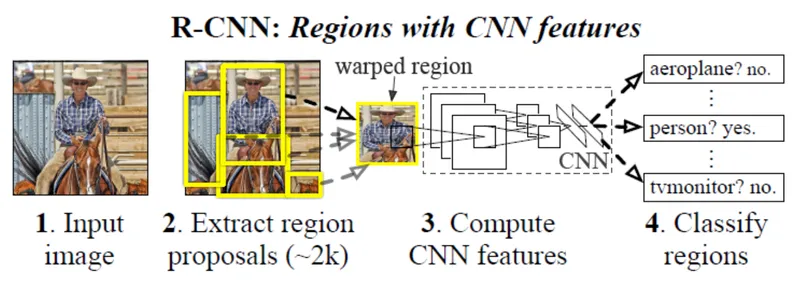
参考:Ross B. Girshick, Jeff Donahue, Trevor Darrell, Jitendra Malik. Rich Feature Hierarchies for Accurate Object Detection and Semantic Segmentation. CVPR 2014: 580-587
实现过程
-
区域划分:给定一张输入图片,从图片中提取2000个类别独立的候选区域,R-CNN 采用的是 Selective Search 算法
-
特征提取:对于每个区域利用CNN抽取一个固定长度的特征向量, R-CNN 使用的是 Alexnet
-
目标分类:再对每个区域利用SVM进行目标分类
-
边框回归:BoundingboxRegression(Bbox回归)进行边框坐标偏移
优化和调整
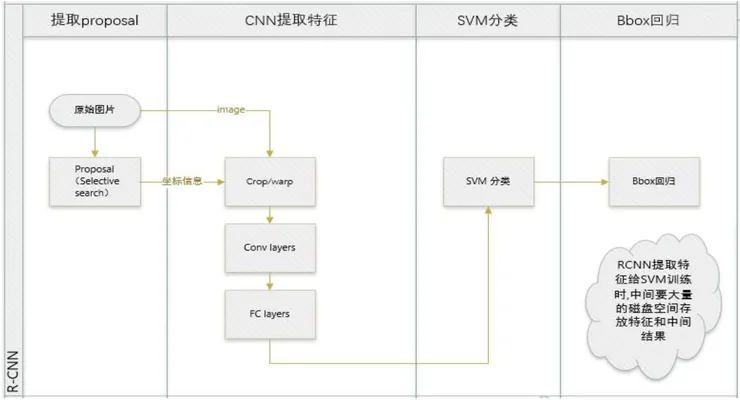
- Crop就是从一个大图扣出网络输入大小的patch,比如227×227
- Warp把一个边界框bounding box的内容resize成227×227
Selective Search 算法
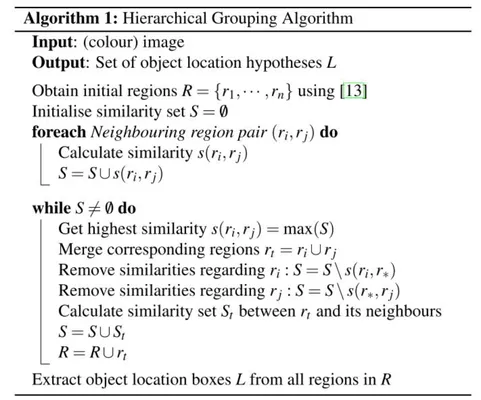
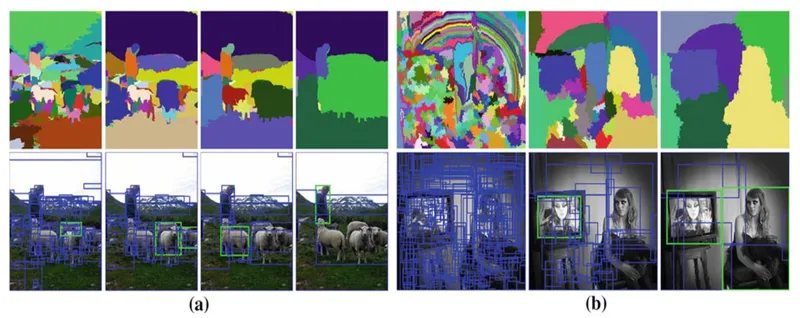
核心思想:图像中物体可能存在的区域应该有某些相似性或者连续性的,选择搜索基于上面这一想法采用子区域合并的方法提取 bounding boxes候选边界框。
- 首先,通过图像分割算法将输入图像分割成许多小的子区域
- 其次,根据这些子区域之间的相似性(主要考虑颜色、纹理、尺寸和 空间交叠4个相似) 进行区域迭代合并。每次迭代过程中对这些合并 的子区域做bounding boxes(外切矩形),这些子区域的外切矩形就是 通常所说的候选框
算法步骤:
- 生成区域集R,参见论文《Efficient Graph-Based Image Segmentation》
- 计算区域集R里每个相邻区域的相似度S=\{s1,s2,...\}
- 找出相似度最高的两个区域,将其合并为新集,添加进R
- 从S中移除所有与step2中有关的子集
- 计算新集与所有子集的相似度
- 跳至step2,直至S为空
Bbox回归
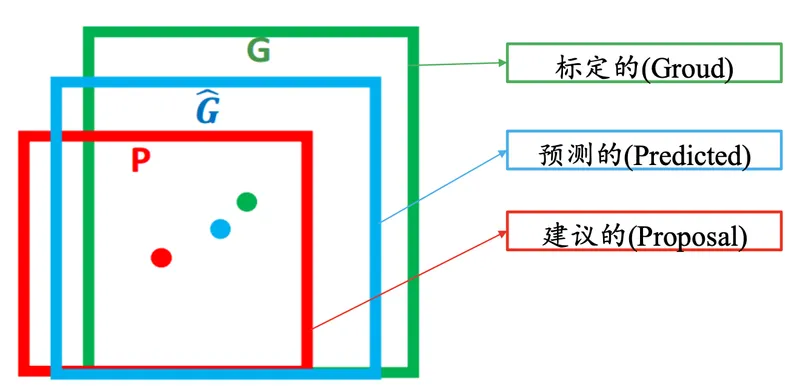
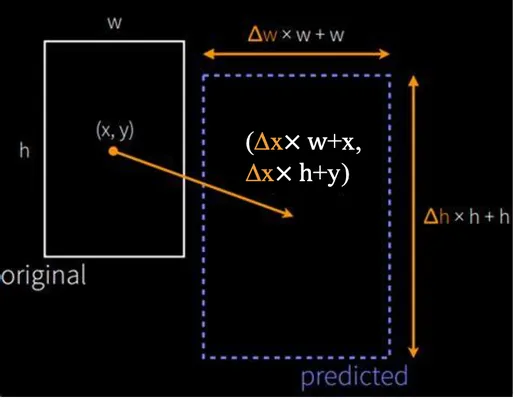
核心思想:通过平移和缩放方法对物体边框进行调整和修正。
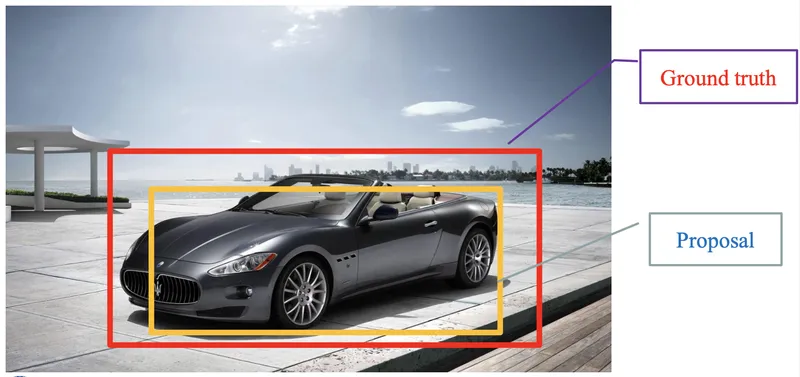
- bounding box的表示为(x,y,w,h),即窗口的中心点坐标和宽高
- Bbox回归就是找到函数 f,将(P_x,P_y, P_w,P_h)映射为更接近 (G_x,G_y, G_w,G_h) 的 (\hat{G}_x,\hat{G}_y, \hat{G}_w,\hat{G}_h)
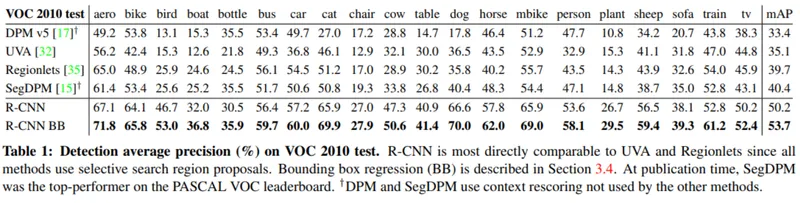
mAP:mean Average Precision,是多标签图像分类任务中的评价指标。AP衡量的是学出来的模型在给定类别上的好坏,而mAP衡量的是学出的模型在所有类别上的好坏。
SPPnet
SPPnet (Spatial Pyramid Pooling):空间金字塔网络,R-CNN主要问题:每个Proposal独立提取CNN features,分步训练。
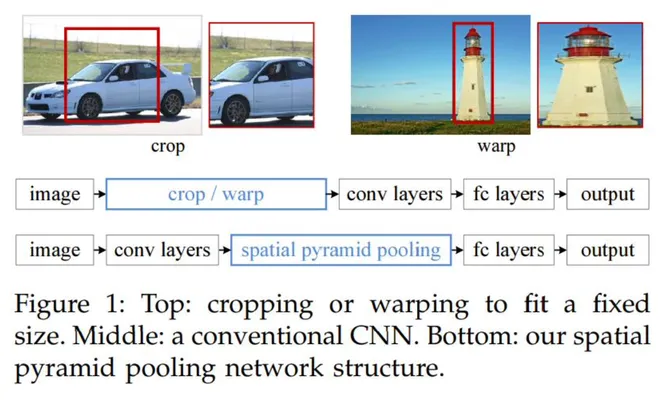
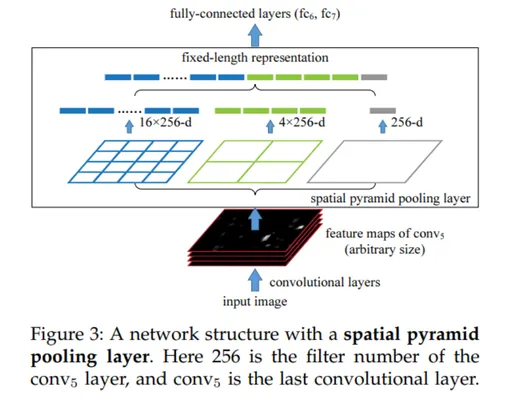
参考:Kaiming He, Xiangyu Zhang, Shaoqing Ren, Jian Sun. Spatial Pyramid Pooling in Deep Convolutional Networks for Visual Recognition. IEEE Trans. Pattern Anal. Mach. Intell. 37(9): 1904-1916 (2015)
Fast R-CNN
- R-CNN和SPPnet问题:训练步骤过多,需要训练SVM分类器,需要 额外的回归器, 特征也是保存在磁盘上。
- 联合学习(jointtraining):把SVM、Bbox回归和CNN阶段一起训 练,最后一层的Softmax换成两个:一个是对区域的分类Softmax, 另一个是对Bounding box的微调。训练时所有的特征不再存到硬盘上,提升了速度。
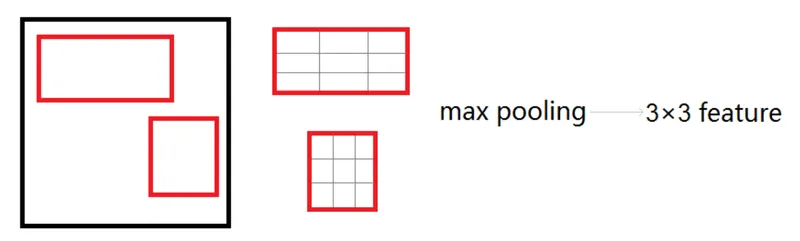
- ROI Pooling层:实现了单尺度的区域特征图的Pooling。
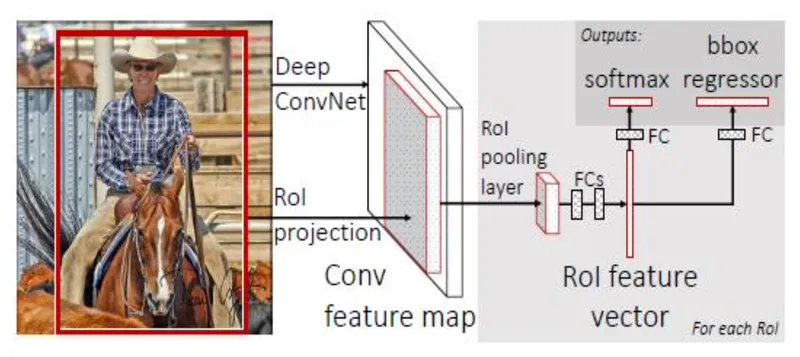
ROI Pooling层:将每个候选区域均匀分成M×N块,对每块进行max pooling,将特征图上大小不一的候选区域转变为大小统一的数据,送入下一层。
性能对比
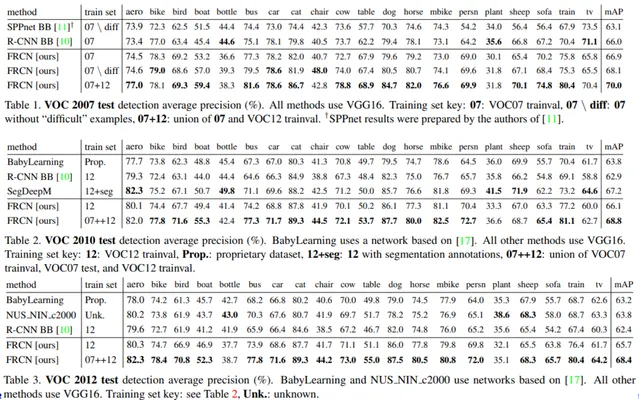
效率对比
- Fast R-CNN trains the very deep VGG16 network 9× faster than R- CNN, is 213× faster at test-time, and achieves a higher mAP on PASCAL VOC 2012.
- Compared to SPPnet, Fast R-CNN trains VGG16 3×faster, tests 10× faster, and is more accurate.
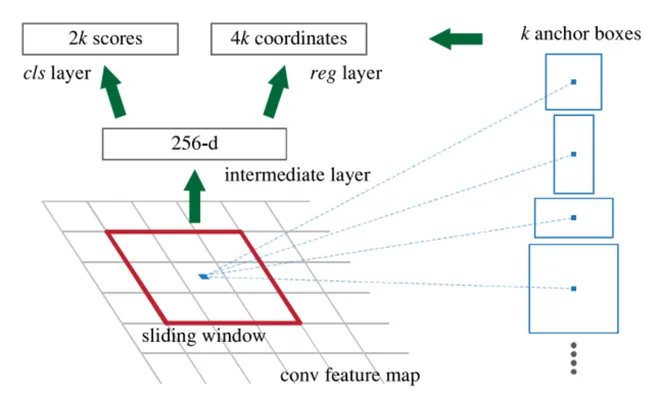
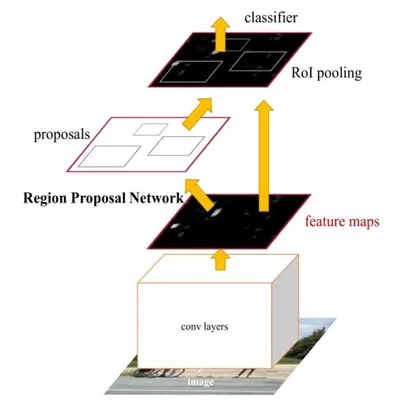
RPN(Region Proposal Network):使用全卷积神经网络来生成区域建议(Region proposal),替代之前的Selective search。
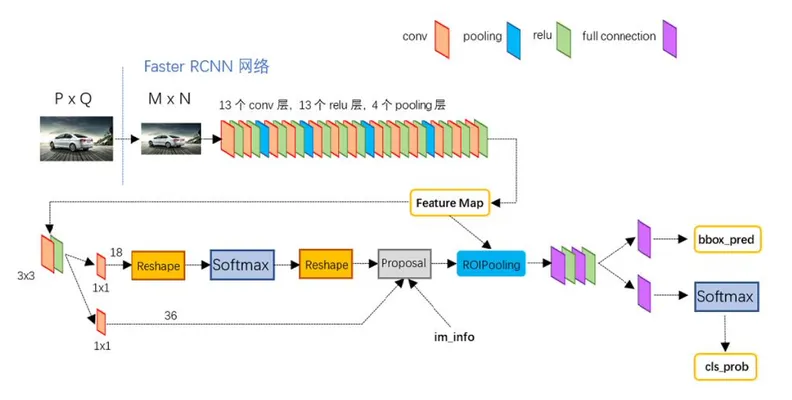
参考:Shaoqing Ren, Kaiming He, Ross B. Girshick, Jian Sun. Faster R-CNN: Towards Real-Time Object Detection with Region Proposal Networks. IEEE Trans. Pattern Anal. Mach. Intell. 39(6): 1137-1149 (2017)
Faster R-CNN训练方式
-
Alternating training
-
Approximate joint training
YOLO系列
- 与R-CNN系列最大的区别是用一个卷积神经网络结构就可以从输入 图像直接预测bounding box和类别概率,实现了End2End训练
- 速度非常快,实时性好
- 可以学到物体的全局信息,背景误检率比R-CNN降低一半,泛化能力强
- 准确率还不如R-CNN高,小物体检测效果较差
参考:Joseph Redmon, Santosh Kumar Divvala, Ross B. Girshick, Ali Farhadi. You Only Look Once: Unified, Real-Time Object Detection. CVPR 2016: 779-788
目标检测和识别
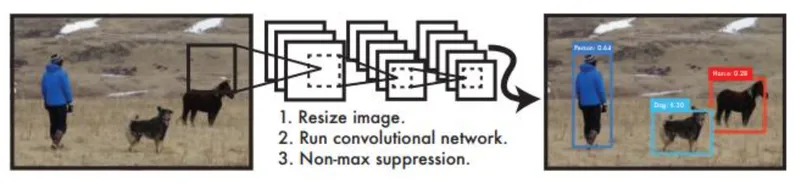
The YOLO Detection System. Processing images with YOLO is simple and straightforward. Our system (1) resizes the input image to 448 ×448, (2) runs a single convolutional network on the image, and (3) thresholds the resulting detections by the model’s confidence.
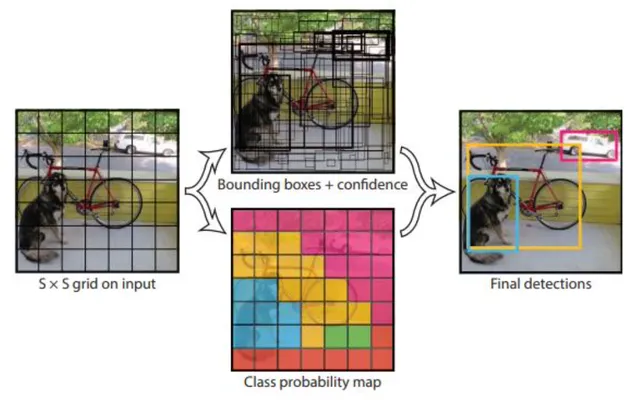
The Model. Our system models detection as a regression problem. It divides the image into an S×S grid and for each grid cell predicts B bounding boxes, confidence for those boxes, and C class probabilities. These predictions are encoded as an S×S×(B∗5+ C) tensor.
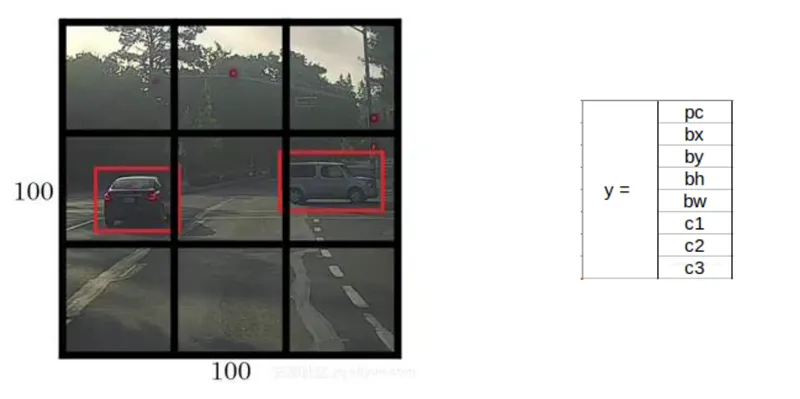
网络结构:24个卷积层和2个全连接层
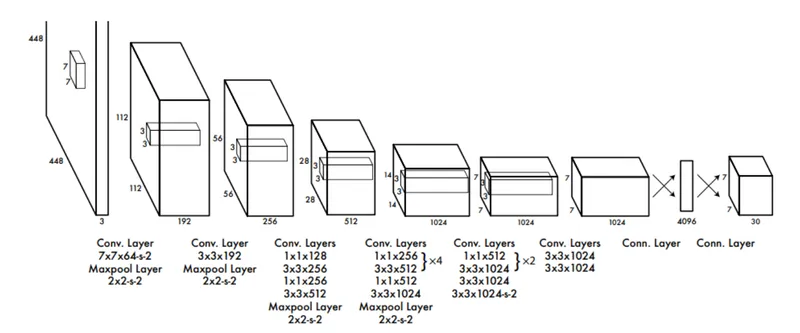
The Architecture. Our detection network has 24 convolutional layers followed by 2 fully connected layers. Alternating 1×1 convolutional layers reduce the features space from preceding layers. We pretrain the convolutional layers on the ImageNet classification task at half the resolution (224 ×224 input image) and then double the resolution for detection.
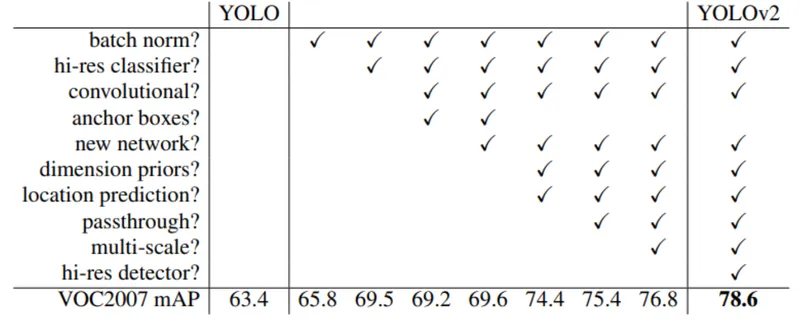
YOLO2和YOLO9000
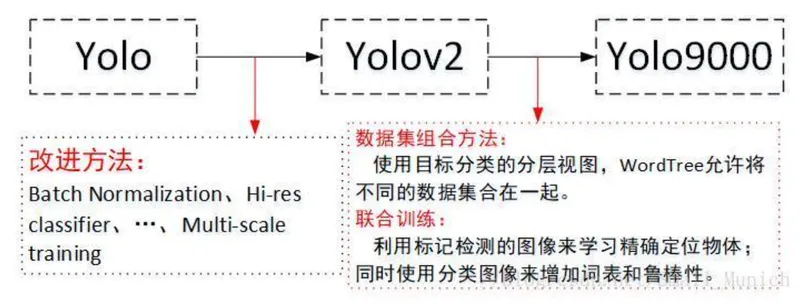
参考:Joseph Redmon, Ali Farhadi. YOLO9000: Better, Faster, Stronger. CVPR 2017: 6517-6525
性能分析