RL系统深思:深入理解权重更新机制
文档摘要
RL 系统深思:深入理解权重更新机制 因为工作需要,最近终于得空能够再次深入去学习思考主流 RL 框架的系统设计。我们希望能够通过一系列文档分享我们的思考,也希望能够得到大家的反馈,和志同道合的朋友一同打造更好的开源 RLHF 框架。我们将这系列文章称为 RL 系统深思。本文是这系列的第一篇,重点讨论各类权重更新机制。本文首先分析 verl 这种 co-locate 策略下的权重更新方式,也是我自己第一次从头到尾理解了基于 handle tuple 重建 tensor 来实现的权重更新。接着,我们会剖析 slime 框架下的权重更新模式,重点分析其独出心裁的桶更新策略。最后,我们横向对比三种权重更新方式,浅浅分享我个人的一些想法,欢迎大家批评指正。
RL 系统深思:深入理解权重更新机制
因为工作需要,最近终于得空能够再次深入去学习思考主流 RL 框架的系统设计。我们希望能够通过一系列文档分享我们的思考,也希望能够得到大家的反馈,和志同道合的朋友一同打造更好的开源 RLHF 框架。我们将这系列文章称为 RL 系统深思。本文是这系列的第一篇,重点讨论各类权重更新机制。本文首先分析 verl 这种 co-locate 策略下的权重更新方式,也是我自己第一次从头到尾理解了基于 handle tuple 重建 tensor 来实现的权重更新。接着,我们会剖析 slime 框架下的权重更新模式,重点分析其独出心裁的桶更新策略。最后,我们横向对比三种权重更新方式,浅浅分享我个人的一些想法,欢迎大家批评指正。
照理,感谢参与本文档讨论和撰写的所有朋友们:
zhuoran yin(CMU),changyi yang(CMU),ji li(蚂蚁),chengxi li(CMU),biao he(Linkedin),junrong lin(Qwen),Shan Yu(UCLA),Xinyuan Tong(chenyang 的小吗喽),chenyang zhao(Amazon)
排名按照微信群的成员顺序
verl 当中 co-locate 策略的权重更新
从逻辑上,在 co-locate 策略下的权重更新都是类似的,我们以 FSDP training backend 为例,给出一个简化而通用的更新流程,核心就是这样一个代码片段:
def _preprocess_tensor_for_update_weights(tensor: torch.Tensor): if isinstance(tensor, DTensor): return tensor.full_tensor() return tensor async def update_weights(self, params): named_tensors = [(k, v) for k, v in params.items()] load_format = None for tensor_index, (name, tensor) in enumerate(named_tensors): serialized_tensor = MultiprocessingSerializer.serialize(_preprocess_tensor_for_update_weights(tensor)) if self.device_mesh["infer_tp"].get_local_rank() == 0: gathered_serialized_tensors = [None for _ in range(self.device_mesh["infer_tp"].mesh.size()[0])] else: gathered_serialized_tensors = None dist.gather_object( obj=serialized_tensor, object_gather_list=gathered_serialized_tensors, dst=self.device_mesh["infer_tp"].mesh.tolist()[0], group=self.device_mesh["infer_tp"].get_group(), ) if self.device_mesh["infer_tp"].get_local_rank() == 0: await self.inference_engine.update_weights_from_tensor( named_tensors=[ ( name, LocalSerializedTensor(values=gathered_serialized_tensors), ) ], load_format=load_format, flush_cache=tensor_index == len(named_tensors) - 1, )
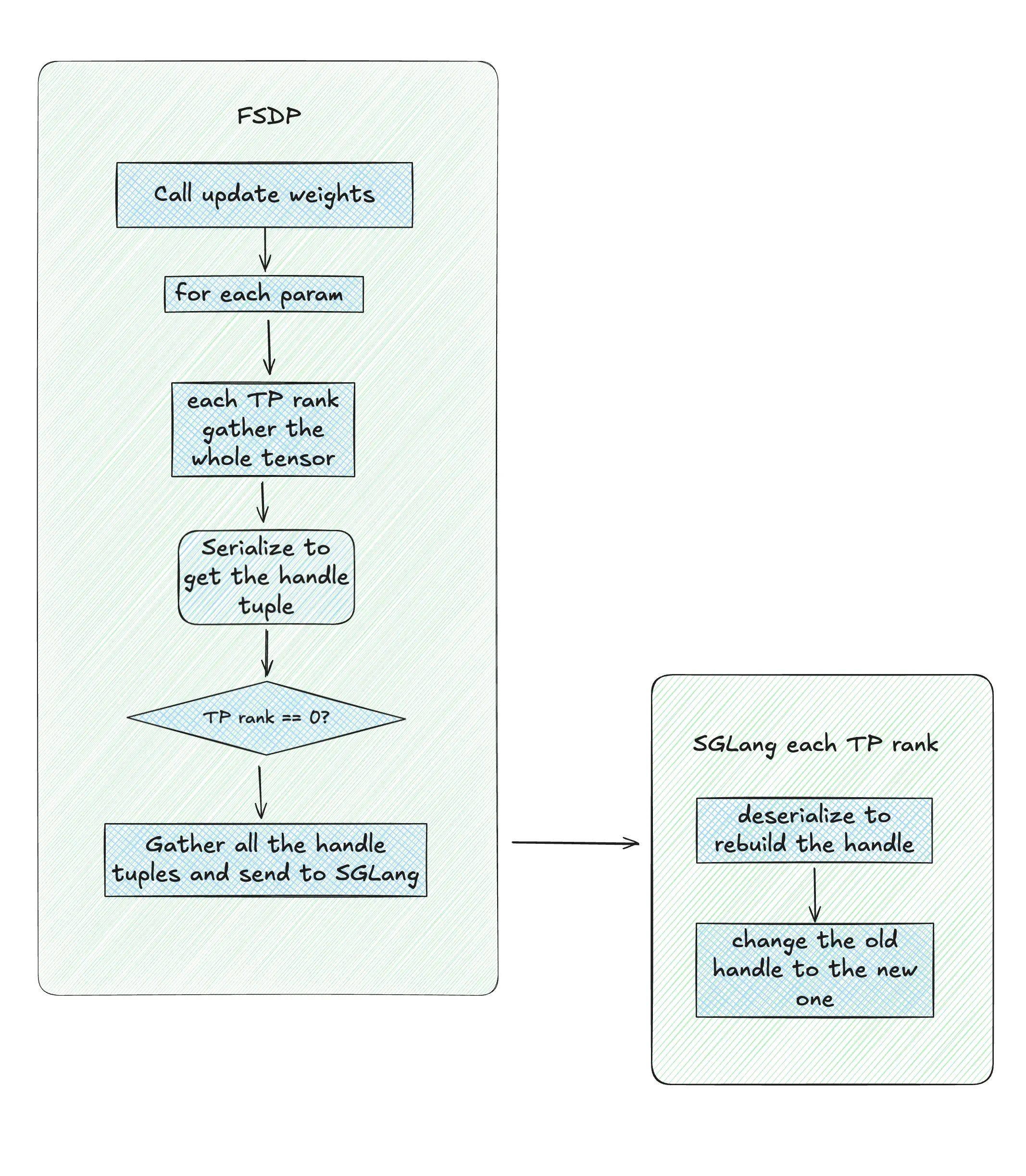
参数是逐个进行聚合并且更新的,更新完一个参数后 release 一个,然后继续循环。我们以单个参数为例。假设这个参数的 size 是 [1024, 1024],FSDP 的 TP size 是 4,而 SGLang 的 TP size 是 2。因此在更新参数开始前, 每个 rank 上在 FSDP engine 内有 [256, 1024] 大小的 tensor,而 SGLang engine 有 [512, 1024] 大小的 tensor。
- 权重导出:每个 rank 调用
_preprocess_tensor_for_update_weights()将当前参数的完整 tensor 进行聚合,实际上把分散在各个 GPU 上的参数分片都聚合到了每个 rank 上,每个 rank 上都有一份当前参数的完整 tensor。此时,这个 parameter 会有三份,前两份是 FSDP 和 SGLang 本身就有的[512, 1024]和[256, 1024],第三份是为了聚合而单独开辟的[1024, 1024]大小的 tensor。 - tensor 序列化:调用
MultiprocessingSerializer.serialize(),将每个 rank 上聚合到的参数序列化,得到序列化后的 handle tuple,称为serialized_tensor。注意,虽然序列化传入的参数是聚合得到的那个[1024, 1024]的 tensor,但是实际上返回的只有被序列化的 handle tuple。handle tuple 近似于指向 tensor 实际存储的指针,存放了虚拟地址,stripe,size 等等信息,以及后续在 SGLang engine 侧重建 tensor 需要共享的 CUDA IPC handler。 - 聚合 handle tuple 到 FSDP TP 0:虽然每个 rank 上都聚合了当前参数的完整 tensor,但是只有 tp 0 通过
gather_object收集了所有 rank 的 handle tuple。 - 跨进程传递:FSDP TP rank 0 将收集到的 handle tuple 列表打包为
LocalSerializedTensor对象用于后续重建。接着,通过跨进程通信传递给 SGLang Engine。这里传递的只有序列化后的 handle tuple,而非实际数据。 - SGLang Engine 重建 tensor:SGLang 的每个 TP rank 调用
_unwrap_tensor(),顺着LocalSerializedTensor.get -> MultiprocessingSerializer.deserialize向下调用,反序列化恢复了在 FSDP 侧聚合得到的完整 tensor 的 handle tuple。接着,构造新的 python tensor 对象,将刚刚恢复的 handle tuple 作为新的 Python tensor 对象的 handle tuple。新的 tensor 对象和 FSDP 侧聚合得到的完整 tensor 共享了 handle tuple,也共享了一切 meta data,必然指向了同一块显存,完成了所谓的 tensor 重建过程。 - SGLang engine load weights:重建后的 tensor 传递给
ModelRunner.load_weights,将原本这个 parameter 的 tensor 更换为新的 tensor,完成整个参数更新过程。
由此以来,其实在任意一个 TP 上,只是临时创建了一个 [1024, 1024] 的 tensor,然后原本的 handler 被更换后,这个 [1024, 1024] 的 tensor 所不用的那一半会被 release 掉,原本 SGLang engine 里面的 handler 指向的旧的 tensor 会被释放掉,并没有显存泄露。
权重导出
权重导出和 handle tuple 序列化在同一行完成:
def _preprocess_tensor_for_update_weights(tensor: torch.Tensor): if isinstance(tensor, DTensor): return tensor.full_tensor() return tensor serialized_tensor = MultiprocessingSerializer.serialize(_preprocess_tensor_for_update_weights(tensor))
在将训练阶段结束后,首先使用 FSDP state_dict 导出权重。一般而言,state_dict 是一个 param name -> tensor 的 dict,而 FSDP 中的 state_dict 的值取决于 StateDictType 的模式。FSDP 内置了三种模式:FULL_STATE_DICT、SHARDED_STATE_DICT 以及 LOCAL_STATE_DICT。我们分别来看看这三种模式假设有一个 4-rank FSDP 训练,参数形状为 [1024, 1024],每个 rank 负责 1/4 的参数:
FULL_STATE_DICT
# 每个 rank 都得到完整的参数 { 'layer1.weight': tensor([1024, 1024]), # 完整张量,每个 rank 都相同 'layer1.bias': tensor([1024]), # 完整张量,每个 rank 都相同 # ... 所有参数都是完整的 }
LOCAL_STATE_DICT
# 每个 rank 只得到自己负责的分片 { 'layer1.weight': tensor([256, 1024]), # 当前 rank 的分片 (1/4) 'layer1.bias': tensor([256]), # 当前 rank 的分片 (1/4) # ... 只有当前 rank 负责的参数分片 }
SHARDED_STATE_DICT
# 每个 rank 得到包含元信息的分片对象 { 'layer1.weight': ShardedTensor { metadata: { "world_size": 4, # 总分片数 "rank": 1, # 当前分片索引 (0-3) "shape": [1024, 1024], # 完整张量的形状 "dtype": torch.float16, # 数据类型 }, local_shard: tensor([256, 1024]), # 当前 rank 的分片数据 }, 'layer1.bias': ShardedTensor { metadata: { "world_size": 4, "rank": 1, "shape": [1024], "dtype": torch.float16 }, local_shard: tensor([256]), # 当前 rank 的分片数据 } }
其中 FULL_STATE_DICT 是最朴素的实现方式。LOCAL_STATE_DICT 只保存当前 rank 所存储的部分,没有切片信息,而 SHARDED_STATE_DICT 在 LOCAL_STATE_DICT 基础上,额外存有当前 rank 负责的参数分片和切片信息。通过 full_tensor() 就可以将 SHARDED_STATE_DICT 状态下的 tensor 聚合起来:
if isinstance(tensor, DTensor): return tensor.full_tensor()
tensor 序列化
序列化由 MultiprocessingSerializer.serialize 完成,如同前文所说,序列化一个 tensor 实际上得到的返回值是序列化后的 handler,或者更严谨的说法是 handler tuple。我们来看看序列化最后层层向下调用的 reduce_tensor() 函数的返回值:
return ( rebuild_cuda_tensor, # 重建函数 ( type(tensor), # tensor 类型 tensor.size(), # tensor 大小 tensor.stride(), # tensor 步长 tensor_offset, # tensor 在 storage 中的偏移量 type(storage), # storage 类型 tensor.dtype, # tensor 数据类型 device, # tensor 设备 handle, # identifier which CUDA allocation is the storage in. storage_size_bytes, # storage 大小 storage_offset_bytes, # storage 在 CUDA allocation 中的偏移量 tensor.requires_grad, # tensor 是否需要梯度 ref_counter_handle, # 引用计数器 handle ref_counter_offset, # 引用计数器偏移量 event_handle, # 事件 handle event_sync_required, # 事件同步是否需要 ), )
可见,对一个 CUDA Tensor 调用 reduce_tensor,实际上返回的是一个 Python Tuple,包含了重建 Tensor 所需的一切,而绝不包含实际存储的数据本身。接着,这个 handler tuple 通过进程间通信(比如 zmq)传递给接收方。接收方拿到的自然也不是数据本身,而是一组可以帮助重新找到(重建)这个 tensor 的 handler,我们在后文中会以 handler tuple 来指代。
聚合 handler
注意到,在聚合 tensor 并且序列化的过程中,从未指定不同 tp 的区别,可见对于当前正在更新的参数,每个 tp 上都会额外申请一片显存空间,聚合得到完整的 tensor,并且序列化得到其 handler tuple。考虑到单个参数并不大,这种做法仍旧安全。接着,每个 tp 都得到 handle tuple 后,将 handle tuple 也进行聚合:
if self.device_mesh["infer_tp"].get_local_rank() == 0: gathered_serialized_tensors = [None for _ in range(self.device_mesh["infer_tp"].mesh.size()[0])] else: gathered_serialized_tensors = None dist.gather_object( obj=serialized_tensor, object_gather_list=gathered_serialized_tensors, dst=self.device_mesh["infer_tp"].mesh.tolist()[0], group=self.device_mesh["infer_tp"].get_group(), )
这里使用 dist.gather_object 来聚合所有 TP rank 的 handler tuple。与 all_gather 不同,gather_object 是一个单向聚合操作:
- 所有 TP rank 都参与发送:每个 rank 都调用
dist.gather_object发送自己的serialized_tensor - 只有目标 rank 接收:只有
dst指定的 rank(这里是 TP rank 0)会接收到完整的 handler tuple 列表 - 其他 rank 不接收:非目标 rank 的
gathered_serialized_tensors保持为None
这样设计的好处是:后续只需要 TP rank 0 将收集到的所有 handler tuple 传递给 SGLang Engine,避免了每个 rank 都持有完整 handler tuple 列表的内存浪费。
SGLang 完成 tensor 重建
下一步,将聚合好的 handler tuple list 传递给 SGLang Engine,并且调用 update_weights_from_tensor 接口。
if self.device_mesh["infer_tp"].get_local_rank() == 0: await self.inference_engine.update_weights_from_tensor( named_tensors=[ ( name, LocalSerializedTensor(values=gathered_serialized_tensors), ) ], load_format=load_format, # 实际上传入的是 None flush_cache=tensor_index == len(named_tensors) - 1, )
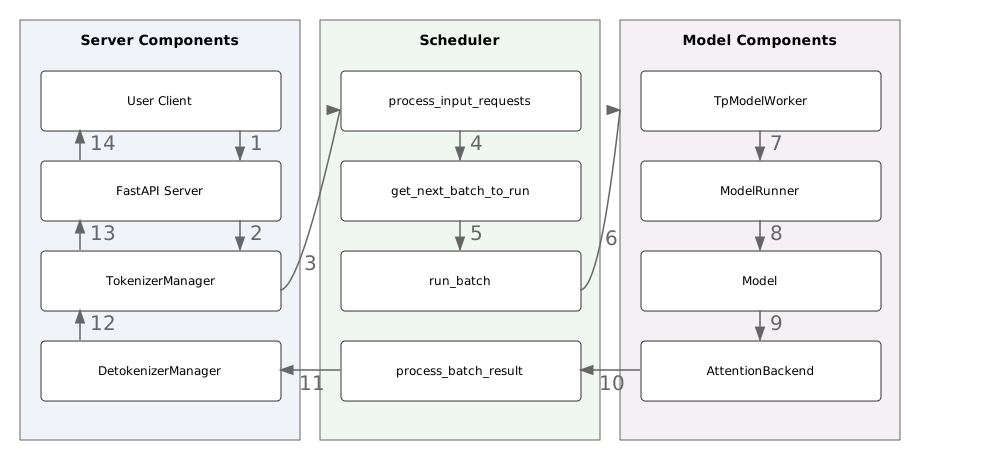
接着,代码来到 SGLang 一侧,我们查看 ModelRunner.update_weights_from_tensor 的源码。注意到,对于 SGLang 而言,ModelRunner 是一个非常底层的类了,再往上是有 TpModelManger 的。也就是说,这个 update_weights_from_tensor 实际上是 SGLang 的每个 TP rank 都会调用。具体的 SGLang 架构可以参考此图:
我们还是回到主线上,研究下 SGLang 底层在每个 TP rank 上执行的 update_weights_from_tensor 接口:
def update_weights_from_tensor( self, named_tensors: List[Tuple[str, Union[torch.Tensor, "LocalSerializedTensor"]]], load_format: Optional[str] = None, ): named_tensors = [ (name, _unwrap_tensor(tensor, tp_rank=self.tp_rank)) for name, tensor in named_tensors ] if load_format == "direct": _model_load_weights_direct(self.model, named_tensors) elif load_format in self.server_args.custom_weight_loader: custom_loader = dynamic_import(load_format) custom_loader(self.model, named_tensors) elif load_format is None: self.model.load_weights(named_tensors) else: raise NotImplementedError(f"Unknown load_format={load_format}") return True, "Success" def _unwrap_tensor(tensor, tp_rank): if isinstance(tensor, LocalSerializedTensor): monkey_patch_torch_reductions() tensor = tensor.get(tp_rank) return tensor.to(torch.cuda.current_device()) @dataclass class LocalSerializedTensor: """torch.Tensor that gets serialized by MultiprocessingSerializer (which only serializes a pointer and not the data). The i-th element in the list corresponds to i-th rank's GPU.""" values: List[bytes] def get(self, rank: int): return MultiprocessingSerializer.deserialize(self.values[rank])
每个 tp rank 调用 _unwrap_tensor 接口,在 tensor.get(tp_rank) 一步中,顺着 LocalSerializedTensor.get -> MultiprocessingSerializer.deserialize 向下调用,反序列化恢复了在 FSDP 侧聚合得到的完整 tensor 的 handler tuple。接着,构造新的 python tensor 对象,将刚刚恢复的 handler tuple 作为新的 Python tensor 对象的 handle tuple。这样一来,通过共享 handle 的机制,新的 tensor 对象和 FSDP 侧聚合得到的完整 tensor 共享了一切 meta data,自然也指向了同一块显存,完成了所谓的 tensor 重建过程。重建结束后,这个新的 tensor 对象被传递给 ModelRunner.load_weights,在 SGLang 底层把原本的 tensor 更换掉即可。
slime 中的权重同步策略
有了前文对 update_weights_from_tensor 的理解,我们进一步分析 slime 在 co-locate 策略下的权重同步策略。slime 是一套同时支持 dis-aggregate 和 co-locate 策略的轻量级框架。在技术选型上,slime 选择了 Ray 作为通信框架,Training Backend 选择 Megatron,Rollout Backend 选择 SGLang。出于设计和技术选型的精简,整个 slime 的代码非常清爽。我们后续会有更多分享。这里先顺着上文继续分享 slime 在 co-locate 策略下的权重同步策略。
在 co-locate 策略下,rollout engine 和 training engine 需要不断 offload 与 upload,来互相让出显存。SGLang 通过 torch memory savor 进行 offload 管理,而 Megatron 通过 CuMemAllocator 进行 offload 管理。从逻辑上,Rollout 结束后,通过 mem savor 直接 release 掉物理占用,然后启动 megatron 进行训练。训练结束后,将 megatron 的 model weights 和 optimizer 全都 offload 到 CPU 上,然后将 SGLang 的 model weights 还有 KV cache upload 到 GPU 上。
这时候就很有意思了。为了接下来的参数更新,slime 会分桶将 megatron 的 model weights upload 到 GPU 上,然后和 verl 中的操作类似,聚合得到完整的 tensor,然后序列化得到 handle tuple,然后传递 handle tuple 给 rollout engine,调用 update_weights_from_tensor 接口完成参数更新。
有一个问题非常值得分享:为什么 slime 需要先将 megatron 的 model weights offload 掉再 upload 上来,直接保留在 GPU 上不行吗?
答案在于 slime 对权重更新的处理更为精细。具体来说,为了避免超大规模 MOE model 直接整个 model weights upload 到 GPU 上和 SGLang 并存导致 OOM,slime 对 params 进行了分桶更新。每次只更新桶内的一小部分参数。如果采用和 verl 类似的方法,将整个 FSDP 的参数保留在 GPU 上,对于非常大的模型,除非 tp 开的很大,还是很容易 OOM 的。在此基础上,我们可以发现,slime 的 update weights 阶段其实显存占用几乎只有 SGLang 的 CUDA Graph,model weights 和 KV cache,megatron upload 上来的参数占用显存很少。所以理论上 slime 不需要我们在 verl 里面做的那套复杂的 mutli-stage wake up 机制,也可以设置 SGLang 的 mem static fraction 在一个很高的水平。不过可惜,由于 megatron 的 offload 没有那么完美,目前的 mem static 还有改进空间。我们 LMSYS 也在和 slime 团队通力合作,展开优化。
好了,有了这些基础,我们来速览 slime 在 co-locate 策略下具体的权重更新:
- 建立通讯组:为了在更新权重时能够聚合 handle tuple,在启动 slime 时就会建立一个包含所有 rollout engine 和 training engine 的 process group,也即
_ipc_gather_group,并设定通信后端为nccl。 - 清空 kv cache: rollout engine 更新参数后,所有先前的 kv cache 无法继续使用。故而在 rollout engine 更新参数前,先向所有 rollout engine 发送 flush cache 来清除 radix tree,确保旧的 kv cache 不影响新一轮的 rollout。
- 权重聚合: 构造分桶,然后将桶内的 megatron model weights 从 CPU upload 到 GPU。接着,先在 PP/EP 组内做
broadcast,在 PP/EP 维度保证每个 rank 拥有完整参数,再通过dist.all_gather+torch.cat完成 TP 层面的聚合,得到完整的 tensor。verl 主要是维护只有 TP 层面的参数,可以通过full_tensor直接将这一维度的DTensor聚合成 tensor。在 slime 中,存在不同切分方式的多维度并行,所以不能简单地用full_tensor,需要手动聚合。 - tensor 序列化并聚合 handle tuple: 与 verl 一样,使用
MultiprocessingSerializer.serialize进行序列化,得到 handle tuple;接着,通过dist.gather()完成 handle tuple 的聚合。 - 传递 handler tuples 并重建参数完成更新: 这里和前文非常类似了,将聚合的 handler tuple 传递给 SGLang Engines,然后在 SGLang 侧反序列化,重建参数,然后调用
ModelRunner.load_weights完成参数更新。
以下列举一些相关代码便于理解:
slime 权重更新代码
def update_weights_from_tensor(self): pp_size = mpu.get_pipeline_model_parallel_world_size() ep_size = mpu.get_expert_model_parallel_world_size() rank = dist.get_rank() if rank == 0: ray.get([engine.reset_prefix_cache.remote() for engine in self.rollout_engines]) dist.barrier() for param_infos in self.param_info_buckets: # init params: params = [] for info in param_infos: if dist.get_rank() == info.src_rank: params.append( torch.nn.Parameter(self.params_dict[info.name].to(device=torch.cuda.current_device())) ) else: params.append(torch.empty(info.shape, dtype=info.dtype, device=torch.cuda.current_device())) # broadcast params across pp ranks if pp_size > 1: handles = [] for info, param in zip(param_infos, params): if info.src_rank in dist.get_process_group_ranks(mpu.get_pipeline_model_parallel_group()): handles.append( torch.distributed.broadcast( param, src=info.src_rank, group=mpu.get_pipeline_model_parallel_group(), async_op=True ) ) for handle in handles: handle.wait() # broadcast params across ep ranks if ep_size > 1: handles = [] for info, param in zip(param_infos, params): if ".experts." in info.name: src_rank = ( info.src_rank if info.src_rank in dist.get_process_group_ranks(mpu.get_expert_model_parallel_group()) else rank ) handles.append( torch.distributed.broadcast( param, src=src_rank, group=mpu.get_expert_model_parallel_group(), async_op=True ) ) for handle in handles: handle.wait() converted_named_tensors = [] for info, param in zip(param_infos, params): # set tp attrs for key, value in info.attrs.items(): setattr(param, key, value) # gather param param = update_weight_utils.all_gather_param(info.name, param) param = update_weight_utils.remove_padding(info.name, param, self.vocab_size) converted_named_tensors.extend( update_weight_utils.convert_to_hf( self.args, self.model_name, info.name, param, self.quantization_config ) ) self._update_converted_params_from_tensor(converted_named_tensors) def all_gather_param(name, param): if "expert_bias" in name: return param assert hasattr(param, "tensor_model_parallel"), f"{name} does not have tensor_model_parallel attribute" if not param.tensor_model_parallel: # if mpu.get_tensor_model_parallel_world_size() == 1: return param.data if ".experts." in name: tp_size = mpu.get_expert_tensor_parallel_world_size() tp_group = mpu.get_expert_tensor_parallel_group() else: tp_size = mpu.get_tensor_model_parallel_world_size() tp_group = mpu.get_tensor_model_parallel_group() param_partitions = [torch.empty_like(param.data) for _ in range(tp_size)] dist.all_gather(param_partitions, param.data, group=tp_group) partition_dim = param.partition_dim assert param.partition_stride == 1, "partition_stride != 1 is not supported" # TODO: here we did an extra copy during concat, maybe merge this with convert_to_hf is better? # TODO: check only GLU is used. if "linear_fc1.weight" in name: param_partitions = [p.chunk(2, dim=0) for p in param_partitions] param_partitions = [p[0] for p in param_partitions] + [p[1] for p in param_partitions] # this is bug in megatron's grouped moe. if "linear_fc2.weight" in name: if partition_dim == 0: partition_dim = 1 param = torch.cat(param_partitions, dim=partition_dim) return param def _update_converted_params_from_tensor(self, converted_named_tensors): ipc_handle = MultiprocessingSerializer.serialize(converted_named_tensors, output_str=True) ipc_handles = ( [None] * dist.get_world_size(self._ipc_gather_group) if self._ipc_gather_src == dist.get_rank() else None ) dist.gather_object( ipc_handle, object_gather_list=ipc_handles, dst=self._ipc_gather_src, group=self._ipc_gather_group, ) if dist.get_rank() == self._ipc_gather_src: ref = self._ipc_engine.update_weights_from_tensor.remote( ipc_handles=ipc_handles, ) ray.get(ref) converted_named_tensors.clear() torch.cuda.empty_cache()
三种权重更新方式的对比
最后,我们对比三种权重更新方式。知易行难,我个人的 RL 系统开发就是从权重更新接口开始的。RL 系统无非就是需要把 inference engine 接进去,每次做一系列推理,然后训练完了更新权重就行了;可是其中的心酸滋味,自然只有真的打磨过,才能体会。我在这里梳理三种权重更新的接口,本质上也是在梳理两种:
-
update_weights_from_disk:这是最简单的接口,在保证 engine 运行的情况下,直接从磁盘读取权重,然后层层向下调用ModelRunner.load_weights接口更新权重。实际使用上,在 RL 过程中每次完成 target policy 的更新,将 target policy 存下来,然后再调用update_weights_from_disk接口更新即可。听上去效率不高,毕竟要将权重写入下层存储,然后再读取上来,整体速度由下层存储的 I/O 效率决定。然而,倘若下层存储的读写速度足够快,或者 SGLang Engine 能够高效并行地去读取磁盘,未必这是个不能采用的方案。此外,在写入下层存储的时候,顺带也完成了 checkpoint 的写入。用其他的接口来更新权重,checkpoint 的管理还需要有另一套异步逻辑。最后,我认为update_weights_from_disk是最能够满足 rollout 动态扩缩容需求的接口。倘若在训练过程中,发现 Rollout 慢的出奇,使用update_weights_from_distributed方案的话,为了进行扩缩容,得先将已有的通讯组暂停,然后加入新的 Rollout Engine,重新建立通讯组,这个过程的工程复杂程度可想而知。如果使用update_weights_from_disk接口,直接在 Rollout Engine 上层的 DP router 上加入一个新的 Rollout Engine,然后所有 Rollout Engine 从同一个 checkpoint 上读取权重用于更新即可。update_weights_from_disk在 co-locate 和 disaggregate 策略下都能使用,但是支持 co-locate 策略的框架基本都采用了update_weights_from_tensor。在主流框架中,AReaL 选择了update_weights_from_disk。 -
update_weights_from_distributed:这是我实现的接口,在逻辑上和update_weights_from_tensor类似,但是 from distributed 是通过 nccl 或者 IB 在不同资源组之间通讯,只能用于 disaggregated 策略。具体来说,在 Training Engine 和 Rollout Engine 分离放置在两个不同的资源组的时,将二者建立一个统一的通讯组。每次 training engine 更新完权重后,将分离的权重逐个 parameter 聚合在 Training Engine 的 TP 0 上,然后从 Training Engine 的 TP 0 传递到 Rollout Engine 的每个 TP 上。Rollout Engine 的每个 TP 再自己 shard 取出需要的部分,然后参数 load 了即可。 -
update_weights_from_tensor:其实和update_weights_from_distributed类似,逻辑上都要走一次聚合,但是如同我们前文的分析,update_weights_from_tensor是只做 handle tuple 序列化传递,不传递实际数据的。from tensor 主要的麻烦是 co-locate 策略常常为了 rollout engine 的严苛 SPMD,对 rollout engine 的侵入性很强。在 MOE 上的很多优化都没法启用,比如经典的 DeepSeek DP Attention,而这在 dis-aggregate 策略下是天然支持的。